

EcoWatch
Facebook 558k Twitter 222k Instagram 52k Subscribe Subscribe
  • Climate
  • Energy
  • Conservation
  • Food + Agriculture
  • Renewables
  • Oceans
  • Policy
  • Insights + Opinion
  • Go Solar Today
      • Top Companies By State
        • California Solar Companies
        • Texas Solar Companies
        • New York Solar Companies
        • Florida Solar Companies
        • See All States
      • Top Incentives By State
        • California Solar Incentives
        • Texas Solar Incentives
        • New York Solar Incentives
        • Florida Solar Incentives
        • See All States
      • Solar Panel Costs By State
        • Solar Panel Costs in California
        • Solar Panel Costs in Texas
        • Solar Panel Costs in New York
        • Solar Panel Costs in Florida
        • See All States
      • Value of Solar by State
        • Is Solar Worth It In California?
        • Is Solar Worth It in Texas?
        • Is Solar Worth It New York?
        • Is Solar Worth It In Florida?
        • See All States
      • Company Reviews
        • Tesla Solar Review
        • Sunrun Solar Review
        • SunPower Solar Review
        • Vivint Solar Review
        • See All Companies
      • Common Solar Questions
        • Can You Get Free Solar Panels?
        • Does Solar Increase Home Value?
        • What’re The Best Solar Batteries?
        • Can You Finance Solar?
        • Where To Buy Solar Panels?
        • Payback On Solar Panels?
      • Solar Resources
        • Interactive Solar Calculator
        • Federal Solar Tax Credit
        • Best Solar Panels For Most Homes
        • Tesla Solar Roof Review
        • Cheapest Solar Panels
      • Companies Compared
        • SunPower vs Tesla Solar
        • SunRun vs Tesla Solar
        • SunRun vs SunPower
        • SunPower vs Momentum Solar
        • SunPower vs ADT Solar
EcoWatch
  • Climate
  • Energy
  • Conservation
  • Food + Agriculture
  • Renewables
  • Oceans
  • Policy
  • Insights + Opinion
  • Go Solar Today
    • Go Solar Today
    • Top Companies By State
      • California Solar Companies
      • Texas Solar Companies
      • New York Solar Companies
      • Florida Solar Companies
      • See All States
    • Top Incentives By State
      • California Solar Incentives
      • Texas Solar Incentives
      • New York Solar Incentives
      • Florida Solar Incentives
      • See All States
    • Solar Panel Costs By State
      • Solar Panel Costs in California
      • Solar Panel Costs in Texas
      • Solar Panel Costs in New York
      • Solar Panel Costs in Florida
      • See All States
    • Value of Solar by State
      • Is Solar Worth It In California?
      • Is Solar Worth It in Texas?
      • Is Solar Worth It New York?
      • Is Solar Worth It In Florida?
      • See All States
    • Company Reviews
      • Tesla Solar Review
      • Sunrun Solar Review
      • SunPower Solar Review
      • Vivint Solar Review
      • See All Companies
    • Common Solar Questions
      • Can You Get Free Solar Panels?
      • Does Solar Increase Home Value?
      • What’re The Best Solar Batteries?
      • Can You Finance Solar?
      • Where To Buy Solar Panels?
      • Payback On Solar Panels?
    • Solar Resources
      • Interactive Solar Calculator
      • Federal Solar Tax Credit
      • Best Solar Panels For Most Homes
      • Tesla Solar Roof Review
      • Cheapest Solar Panels
    • Companies Compared
      • SunPower vs Tesla Solar
      • SunRun vs Tesla Solar
      • SunRun vs SunPower
      • SunPower vs Momentum Solar
      • SunPower vs ADT Solar

The best of EcoWatch right in your inbox. Sign up for our email newsletter!

    • About EcoWatch
    • Contact EcoWatch
    • Terms of Use
    • Privacy Policy
    • Learn About Solar Energy
    Facebook 558k Twitter 222k Instagram 52k
    EcoWatch
    • About EcoWatch
    • Contact EcoWatch
    • Terms of Use
    • Privacy Policy
    • Learn About Solar Energy
    Facebook 558k Twitter 222k Instagram 52k
    Home Pollution

    More Than 800 Tons of Agricultural Pesticides Leach Into World’s Rivers Each Year, Research Finds

    By: Cristen Hemingway Jaynes
    Published: July 13, 2023
    Edited by Chris McDermott
    Facebook icon Twitter icon Pinterest icon Email icon
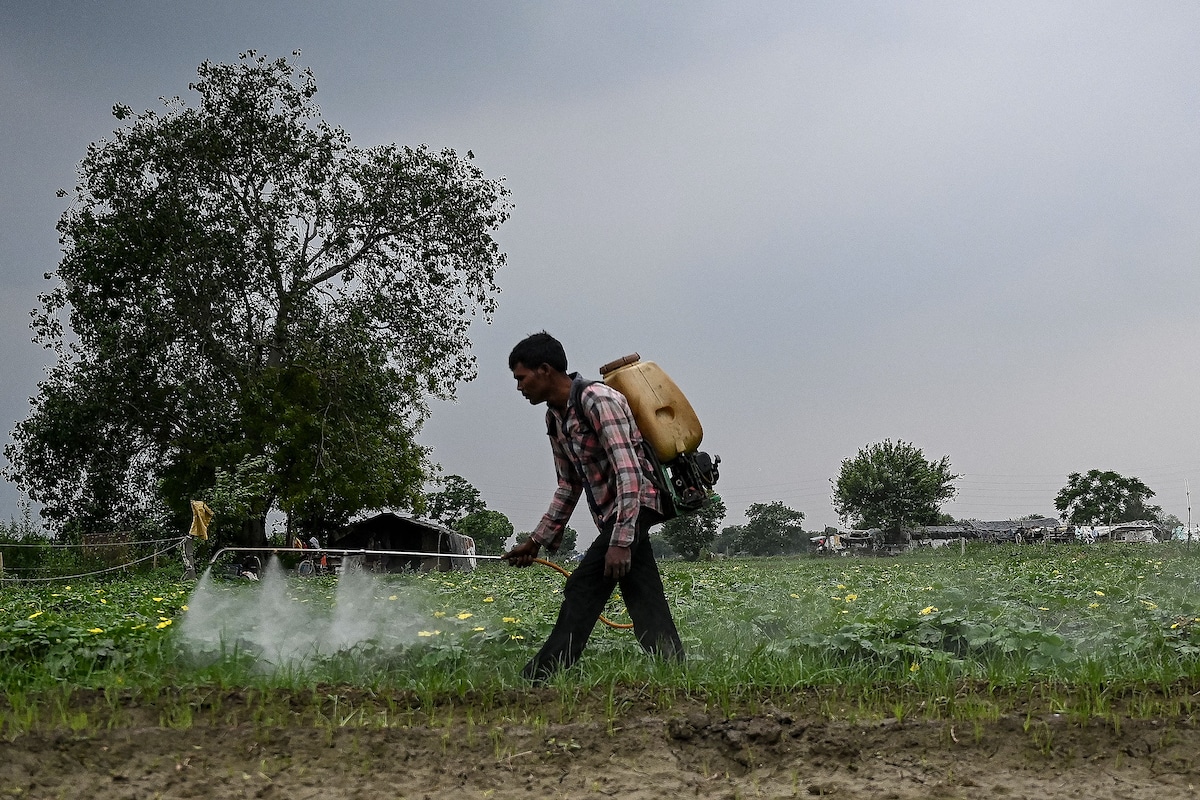
    A farmer sprays pesticides at a farm along the banks of the Yamuna River in New Delhi, India
    A farmer sprays pesticides at a farm along the banks of the Yamuna River in New Delhi, India on May 1, 2023. ARUN SANKAR / AFP via Getty Images
    Why you can trust us

    Founded in 2005 as an Ohio-based environmental newspaper, EcoWatch is a digital platform dedicated to publishing quality, science-based content on environmental issues, causes, and solutions.

    Facebook icon Twitter icon Pinterest icon Email icon

    A new study led by researchers from The University of Sydney has found that agricultural pesticides leach into the world’s rivers and oceans each year at an alarming rate, damaging a variety of ecosystems.

    Every year, agricultural operations around the world use more than three million tons of pesticides, but not a lot is known about precisely where these toxic chemicals go after they are applied to crops, a press release from The University of Sydney said.

    The study looked at where 92 of the most frequently used agricultural pesticides travel after application and found that every year about 77,162 tons of potentially hazardous chemicals leach into aquifers. These pollutants have a damaging effect on freshwater resources and ecosystems.

    More From EcoWatch
    • The Best Solar Panels for Farming
    • What Is Community Solar?
    • How to Fix Underperforming Solar Panels

    “Our study has revealed that pesticides wander far from their original source. In many cases these chemicals end up a long way downstream and often, though in much smaller amounts, all the way to the ocean,” said associate professor Federico Maggi, the study’s lead author from The University of Sydney’s School of Civil Engineering, in the press release.

    The study, “Agricultural pesticide land budget and river discharge to oceans,” was published in the journal Nature.

    The study revealed that approximately 80 percent of pesticides applied to crops end up degrading into byproducts known as “daughter molecules” in the surrounding soil.

    “This degradation of pesticides often occurs as a ‘cascade’ of molecules into the surrounding environment, which can persist in the environment for a long time and can be just as harmful as the parent molecule or applied pesticide. One such example is glyphosate. Although it is highly degradable, it breaks down into a molecule known as AMPA that is both highly persistent and toxic,” Maggi said in the press release.

    The researchers found that, while just a fraction of pesticides make their way into river systems after they are applied, when they do reach the water most of their active ingredients eventually end up in the world’s oceans, bringing negative impacts to coral reefs and marine life, putting both freshwater and marine food chains at risk.

    “On paper, 0.1 percent leaching into fresh waterways might not sound like much,” Maggi said. “But it only takes a tiny amount of pesticides to have a negative impact on the environment.”

    The research revealed that 805 tons of pesticides end up in rivers annually, causing about 8,078 miles of rivers to have chemical concentrations that are higher than the safety limits for some invertebrates and aquatic plants.

    “We must urgently adopt sustainable management strategies to promote reductions in field applications of harmful pesticides and set in place systems to effectively monitor their use under the 2030 Sustainable Development Agenda,” said Dr. Francesco Tubiello, senior environmental statistician at the United Nations’ Food and Agriculture Organization and co-author of the paper, in the press release.

    For the study, the scientists used publicly available geospatial data. But because the analysis did not include all pesticides, the study’s authors said their finds are a conservative estimate. The study did not consider pesticides used in public spaces, private residences, aquaculture or legacy pesticides — chemicals like DDT that have been banned or discontinued due to health risks — and thus the risk of chemical exposure for people and ecosystems could be higher than the findings suggest.

    Maggi said it was possible to reduce pesticides globally while maintaining food security as long as pesticide toxicity and use are reduced in collaboration with food producers, since even low amounts of various highly toxic pesticides present a high risk for some organisms.

    “It is not the pesticide use only that is important,” Maggi said, as The Guardian reported. “What is important is the load – that is, the applied mass and toxicity of individual active ingredients.”

    Maggi and a separate research team outline recommendations for reducing the use of pesticides in another paper published last month in Nature Ecology and Evolution.

    “Globally, there is a lot of room to increase efficiencies and yield while still supporting an abundant food supply through new technology and modern crop management practices,” Maggi said in the press release.

    Subscribe to get exclusive updates in our daily newsletter!

      By signing up, you agree to the Terms of Use and Privacy Policy, and to receive electronic communications from EcoWatch Media Group, which may include marketing promotions, advertisements and sponsored content.

      Cristen Hemingway Jaynes

      Cristen is a writer of fiction and nonfiction. She holds a JD and an Ocean & Coastal Law Certificate from University of Oregon School of Law and an MA in Creative Writing from Birkbeck, University of London. She is the author of the short story collection The Smallest of Entryways, as well as the travel biography, Ernest’s Way: An International Journey Through Hemingway’s Life.
      Facebook icon Twitter icon Pinterest icon Email icon

      Read More

      Methane 101: Understanding the Second Most Important Greenhouse Gas
      By Olivia Rosane and Cristen Hemingway Jaynes
      By EcoWatch
      Mass Die-Off of Western Monarch Butterflies Linked to Pesticides, Study Finds
      A new peer-reviewed study has linked pesticides as a likely
      By Paige Bennett
      Deepest-Known Animal Communities Found Almost Six Miles Below Sea Level
      Thousands of mollusks and worms have been discovered by a
      By Cristen Hemingway Jaynes

      Subscribe to get exclusive updates in our daily newsletter!

        By signing up, you agree to the Terms of Use and Privacy Policy, and to receive electronic communications from EcoWatch Media Group, which may include marketing promotions, advertisements and sponsored content.

        Latest Articles

        • Methane 101: Understanding the Second Most Important Greenhouse Gas
          by EcoWatch
          August 5, 2025
        • New York Finalizes Rule for New Buildings to Be Electric
          by Paige Bennett
          August 4, 2025
        • Mass Die-Off of Western Monarch Butterflies Linked to Pesticides, Study Finds
          by Paige Bennett
          August 1, 2025
        • Deepest-Known Animal Communities Found Almost Six Miles Below Sea Level
          by Cristen Hemingway Jaynes
          August 1, 2025
        • Pristine Forest and Endangered Gorilla Habitat at Risk as Half of DRC Opened to Bids for Oil and Gas Drilling: Report
          by Cristen Hemingway Jaynes
          July 31, 2025
        • Global Hunger Fell Overall in 2024, but Rose in Africa and Western Asia as Climate and Conflict Threaten Progress: UN Report
          by Cristen Hemingway Jaynes
          July 30, 2025
        • Probiotic Found to Slow Disease Spread Among Florida Coral
          by Paige Bennett
          July 29, 2025
        • Earth Overshoot Day Reaches Record for Earliest Date
          by Paige Bennett
          July 28, 2025
        EcoWatch

        The best of EcoWatch right in your inbox. Sign up for our email newsletter!

          • Climate Climate
          • Animals Animals
          • Health + Wellness Health + Wellness
          • Insights + Opinion Insights + Opinion
          • Adventure Adventure
          • Oceans Oceans
          • Business Business
          • Solar Solar
          • About EcoWatch
          • Contact EcoWatch
          • EcoWatch Reviews
          • Terms of Use
          • Privacy Policy
          • Learn About Solar Energy
          • Learn About Deregulated Energy
          • EcoWatch UK
          Follow Us
          Facebook 558k
          Twitter 222k
          Instagram 52k
          Subscribe Subscribe

          Experts for a healthier planet and life.

          Mentioned by:
          Learn more
          • Privacy Policy
          • Terms of Use
          • Your Privacy Choices California Consumer Privacy Act (CCPA) Opt-Out Icon
          © 2026 EcoWatch. All Rights Reserved.

          Advertiser Disclosure

          Our editorial team is committed to creating independent and objective content focused on helping our readers make informed decisions. To help support these efforts we receive compensation from companies that advertise with us.

          The compensation we receive from these companies may impact how and where products appear on this site. This compensation does not influence the recommendations or advice our editorial team provides within our content. We do not include all companies, products or offers that may be available.