

EcoWatch
Facebook 558k Twitter 222k Instagram 52k Subscribe Subscribe
  • Climate
  • Energy
  • Conservation
  • Food + Agriculture
  • Renewables
  • Oceans
  • Policy
  • Insights + Opinion
  • Go Solar Today
      • Top Companies By State
        • California Solar Companies
        • Texas Solar Companies
        • New York Solar Companies
        • Florida Solar Companies
        • See All States
      • Top Incentives By State
        • California Solar Incentives
        • Texas Solar Incentives
        • New York Solar Incentives
        • Florida Solar Incentives
        • See All States
      • Solar Panel Costs By State
        • Solar Panel Costs in California
        • Solar Panel Costs in Texas
        • Solar Panel Costs in New York
        • Solar Panel Costs in Florida
        • See All States
      • Value of Solar by State
        • Is Solar Worth It In California?
        • Is Solar Worth It in Texas?
        • Is Solar Worth It New York?
        • Is Solar Worth It In Florida?
        • See All States
      • Company Reviews
        • Tesla Solar Review
        • Sunrun Solar Review
        • SunPower Solar Review
        • Vivint Solar Review
        • See All Companies
      • Common Solar Questions
        • Can You Get Free Solar Panels?
        • Does Solar Increase Home Value?
        • What’re The Best Solar Batteries?
        • Can You Finance Solar?
        • Where To Buy Solar Panels?
        • Payback On Solar Panels?
      • Solar Resources
        • Interactive Solar Calculator
        • Federal Solar Tax Credit
        • Best Solar Panels For Most Homes
        • Tesla Solar Roof Review
        • Cheapest Solar Panels
      • Companies Compared
        • SunPower vs Tesla Solar
        • SunRun vs Tesla Solar
        • SunRun vs SunPower
        • SunPower vs Momentum Solar
        • SunPower vs ADT Solar
EcoWatch
  • Climate
  • Energy
  • Conservation
  • Food + Agriculture
  • Renewables
  • Oceans
  • Policy
  • Insights + Opinion
  • Go Solar Today
    • Go Solar Today
    • Top Companies By State
      • California Solar Companies
      • Texas Solar Companies
      • New York Solar Companies
      • Florida Solar Companies
      • See All States
    • Top Incentives By State
      • California Solar Incentives
      • Texas Solar Incentives
      • New York Solar Incentives
      • Florida Solar Incentives
      • See All States
    • Solar Panel Costs By State
      • Solar Panel Costs in California
      • Solar Panel Costs in Texas
      • Solar Panel Costs in New York
      • Solar Panel Costs in Florida
      • See All States
    • Value of Solar by State
      • Is Solar Worth It In California?
      • Is Solar Worth It in Texas?
      • Is Solar Worth It New York?
      • Is Solar Worth It In Florida?
      • See All States
    • Company Reviews
      • Tesla Solar Review
      • Sunrun Solar Review
      • SunPower Solar Review
      • Vivint Solar Review
      • See All Companies
    • Common Solar Questions
      • Can You Get Free Solar Panels?
      • Does Solar Increase Home Value?
      • What’re The Best Solar Batteries?
      • Can You Finance Solar?
      • Where To Buy Solar Panels?
      • Payback On Solar Panels?
    • Solar Resources
      • Interactive Solar Calculator
      • Federal Solar Tax Credit
      • Best Solar Panels For Most Homes
      • Tesla Solar Roof Review
      • Cheapest Solar Panels
    • Companies Compared
      • SunPower vs Tesla Solar
      • SunRun vs Tesla Solar
      • SunRun vs SunPower
      • SunPower vs Momentum Solar
      • SunPower vs ADT Solar

The best of EcoWatch right in your inbox. Sign up for our email newsletter!

    • About EcoWatch
    • Contact EcoWatch
    • Terms of Use
    • Privacy Policy
    • Learn About Solar Energy
    Facebook 558k Twitter 222k Instagram 52k
    EcoWatch
    • About EcoWatch
    • Contact EcoWatch
    • Terms of Use
    • Privacy Policy
    • Learn About Solar Energy
    Facebook 558k Twitter 222k Instagram 52k
    Home Health + Wellness

    Processed and Packaged Foods Increase PFAS Levels in Human Blood, Study Finds

    By: Cristen Hemingway Jaynes
    Published: February 19, 2024
    Edited by Chris McDermott
    Facebook icon Twitter icon Pinterest icon Email icon
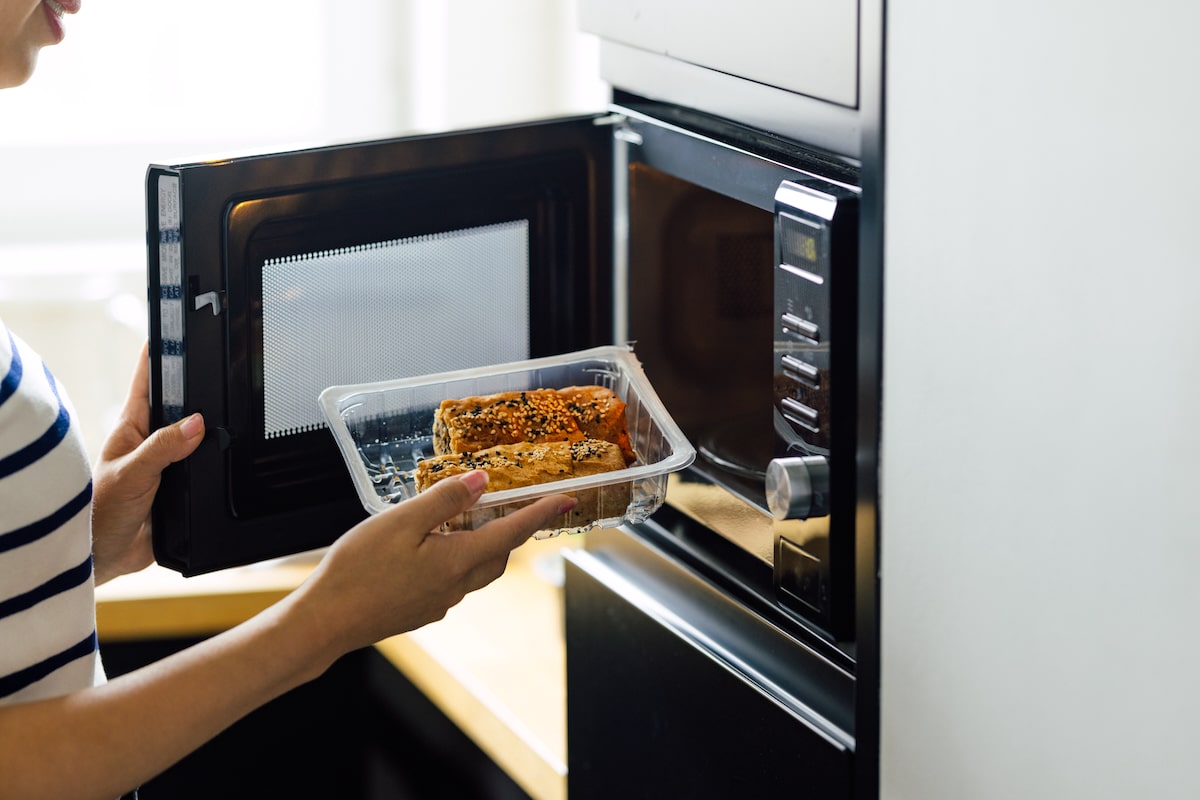
    A person reheats a processed, packaged meal in a microwave oven
    Processed, packaged foods are likely to contain higher levels of PFAS “forever chemicals," a new study finds. FreshSplash / E+ / Getty Images
    Why you can trust us

    Founded in 2005 as an Ohio-based environmental newspaper, EcoWatch is a digital platform dedicated to publishing quality, science-based content on environmental issues, causes, and solutions.

    Facebook icon Twitter icon Pinterest icon Email icon

    A new study led by researchers from University of Southern California (USC)’s Keck School of Medicine has found that certain foods — like processed meats, hot dogs, teas and foods not prepared at home — are likely to contain higher levels of PFAS “forever chemicals.”

    Per- and polyfluoroalkyl substances (PFAS) are a group of thousands of synthetic chemicals used in consumer products and household items like food packaging, nonstick cookware, clothing and furniture. Deemed “forever chemicals” because they do not break down quickly or easily, their widespread use has led to them becoming ubiquitous in water, air and soil, as well as in the bodies of humans and other animals.

    The study found that diet and PFAS exposure are closely linked, and that consumption of foods with higher levels can result in accumulation in the human body over time, a press release from the Keck School of Medicine said.

    “The main takeaway is not to demonize certain foods or say, ‘Oh my gosh, this food is so unhealthy.’ The point is to highlight that we need more testing of these foods, and this gives us an avenue to say, ‘OK, these foods may have higher levels of PFAS so we should do more targeted monitoring of them,’” said Hailey Hampson, lead author of the study and a doctoral student in the division of environmental health at Keck, as The Guardian reported.

    The researchers studied two groups of young adults — 123, primarily Hispanic, with the Southern California Children’s Health Study (CHS), and a “nationally representative sample” of 604 young adults with the National Health and Nutrition Examination Study (NHANES), the press release said. The research team found that consuming certain foods, including those that are prepared at restaurants, was associated with higher PFAS levels in the human body.

    “To our knowledge, this is the first study to examine how dietary factors are associated with changes in PFAS over time,” Jesse A. Goodrich, senior author of the study and a Keck School of Medicine assistant professor of population and public health sciences, said in the press release. “Looking at multiple time points gives us an idea of how changing people’s diets might actually impact PFAS levels.”

    More From EcoWatch
    • The Best Solar Generators
    • The Best Solar Panels for Farming
    • The Best Solar-Powered Water Pumps

    The study was published in the journal Environment International.

    The results highlight the importance of monitoring and testing a variety of foods and beverages for PFAS contamination.

    “We’re starting to see that even foods that are metabolically quite healthy can be contaminated with PFAS,” Hampson said. “These findings highlight the need to look at what constitutes ‘healthy’ food in a different way.”

    Participants in the study answered questions regarding their diets, including the frequency with which they ate certain foods and beverages — such as dark green vegetables, bread, milk, sports drinks and tea. They were also asked how often they consumed foods from fast-food and non-fast-food restaurants and how often they ate home-cooked foods. The researchers used this information to hypothesize how often the participants came into contact with food packaging — a common source of PFAS.

    Blood samples from the participants were tested for PFAS levels. The group from CHS was tested once at roughly the age of 20, as well as at around age 24, while the NHANES group was only tested around the age of 19.

    The CHS group members who reported a higher consumption of tea in the first go-round were found to have higher PFAS levels during the second visit. A 24.8 percent higher level of perfluoro- hexanesulphonic acid (PFHxS) was found with one additional serving, along with a 16.17 percent higher level of perfluoroheptanesulfonic acid (PFHpS) and a 12.6 percent higher incidence of perfluorononanoic acid (PFNA).

    Participants who reported higher pork intake were also found to have higher PFAS levels at the second visit, with one added serving associated with a 13.4 percent higher level of perfluorooctanoic acid (PFOA).

    Foods prepared at home were found to have the opposite effect. Every increase of approximately 7.06 ounces of home-cooked foods equated to 0.9 percent lower baseline levels of perfluorooctanesulfonic acid (PFOS) and 1.6 percent lower at the time of the second visit.

    “It’s really interesting to find that these foods that are maybe not so healthy, when they’re cooked at home were a lower source of PFAS, and that definitely points to food packaging,” Hampson said, according to The Guardian.

    The researchers said the pervasiveness of food packaging might call for a tougher strategy. Last year, an advisory letter was issued by the attorney general of California asking paper straw and food packaging manufacturers to disclose levels of PFAS in their products.

    “That’s a really good step in the right direction, and our findings highlight the need for more of those types of regulations across the country,” Goodrich commented.

    Subscribe to get exclusive updates in our daily newsletter!

      By signing up, you agree to the Terms of Use and Privacy Policy, and to receive electronic communications from EcoWatch Media Group, which may include marketing promotions, advertisements and sponsored content.

      Cristen Hemingway Jaynes

      Cristen is a writer of fiction and nonfiction. She holds a JD and an Ocean & Coastal Law Certificate from University of Oregon School of Law and an MA in Creative Writing from Birkbeck, University of London. She is the author of the short story collection The Smallest of Entryways, as well as the travel biography, Ernest’s Way: An International Journey Through Hemingway’s Life.
      Facebook icon Twitter icon Pinterest icon Email icon

      Read More

      Methane 101: Understanding the Second Most Important Greenhouse Gas
      By Olivia Rosane and Cristen Hemingway Jaynes
      By EcoWatch
      Mass Die-Off of Western Monarch Butterflies Linked to Pesticides, Study Finds
      A new peer-reviewed study has linked pesticides as a likely
      By Paige Bennett
      Deepest-Known Animal Communities Found Almost Six Miles Below Sea Level
      Thousands of mollusks and worms have been discovered by a
      By Cristen Hemingway Jaynes

      Subscribe to get exclusive updates in our daily newsletter!

        By signing up, you agree to the Terms of Use and Privacy Policy, and to receive electronic communications from EcoWatch Media Group, which may include marketing promotions, advertisements and sponsored content.

        Latest Articles

        • Methane 101: Understanding the Second Most Important Greenhouse Gas
          by EcoWatch
          August 5, 2025
        • New York Finalizes Rule for New Buildings to Be Electric
          by Paige Bennett
          August 4, 2025
        • Mass Die-Off of Western Monarch Butterflies Linked to Pesticides, Study Finds
          by Paige Bennett
          August 1, 2025
        • Deepest-Known Animal Communities Found Almost Six Miles Below Sea Level
          by Cristen Hemingway Jaynes
          August 1, 2025
        • Pristine Forest and Endangered Gorilla Habitat at Risk as Half of DRC Opened to Bids for Oil and Gas Drilling: Report
          by Cristen Hemingway Jaynes
          July 31, 2025
        • Global Hunger Fell Overall in 2024, but Rose in Africa and Western Asia as Climate and Conflict Threaten Progress: UN Report
          by Cristen Hemingway Jaynes
          July 30, 2025
        • Probiotic Found to Slow Disease Spread Among Florida Coral
          by Paige Bennett
          July 29, 2025
        • Earth Overshoot Day Reaches Record for Earliest Date
          by Paige Bennett
          July 28, 2025
        EcoWatch

        The best of EcoWatch right in your inbox. Sign up for our email newsletter!

          • Climate Climate
          • Animals Animals
          • Health + Wellness Health + Wellness
          • Insights + Opinion Insights + Opinion
          • Adventure Adventure
          • Oceans Oceans
          • Business Business
          • Solar Solar
          • About EcoWatch
          • Contact EcoWatch
          • EcoWatch Reviews
          • Terms of Use
          • Privacy Policy
          • Learn About Solar Energy
          • Learn About Deregulated Energy
          • EcoWatch UK
          Follow Us
          Facebook 558k
          Twitter 222k
          Instagram 52k
          Subscribe Subscribe

          Experts for a healthier planet and life.

          Mentioned by:
          Learn more
          • Privacy Policy
          • Terms of Use
          • Your Privacy Choices California Consumer Privacy Act (CCPA) Opt-Out Icon
          © 2026 EcoWatch. All Rights Reserved.

          Advertiser Disclosure

          Our editorial team is committed to creating independent and objective content focused on helping our readers make informed decisions. To help support these efforts we receive compensation from companies that advertise with us.

          The compensation we receive from these companies may impact how and where products appear on this site. This compensation does not influence the recommendations or advice our editorial team provides within our content. We do not include all companies, products or offers that may be available.