

EcoWatch
Facebook 558k Twitter 222k Instagram 52k Subscribe Subscribe
  • Climate
  • Energy
  • Conservation
  • Food + Agriculture
  • Renewables
  • Oceans
  • Policy
  • Insights + Opinion
  • Go Solar Today
      • Top Companies By State
        • California Solar Companies
        • Texas Solar Companies
        • New York Solar Companies
        • Florida Solar Companies
        • See All States
      • Top Incentives By State
        • California Solar Incentives
        • Texas Solar Incentives
        • New York Solar Incentives
        • Florida Solar Incentives
        • See All States
      • Solar Panel Costs By State
        • Solar Panel Costs in California
        • Solar Panel Costs in Texas
        • Solar Panel Costs in New York
        • Solar Panel Costs in Florida
        • See All States
      • Value of Solar by State
        • Is Solar Worth It In California?
        • Is Solar Worth It in Texas?
        • Is Solar Worth It New York?
        • Is Solar Worth It In Florida?
        • See All States
      • Company Reviews
        • Tesla Solar Review
        • Sunrun Solar Review
        • SunPower Solar Review
        • Vivint Solar Review
        • See All Companies
      • Common Solar Questions
        • Can You Get Free Solar Panels?
        • Does Solar Increase Home Value?
        • What’re The Best Solar Batteries?
        • Can You Finance Solar?
        • Where To Buy Solar Panels?
        • Payback On Solar Panels?
      • Solar Resources
        • Interactive Solar Calculator
        • Federal Solar Tax Credit
        • Best Solar Panels For Most Homes
        • Tesla Solar Roof Review
        • Cheapest Solar Panels
      • Companies Compared
        • SunPower vs Tesla Solar
        • SunRun vs Tesla Solar
        • SunRun vs SunPower
        • SunPower vs Momentum Solar
        • SunPower vs ADT Solar
EcoWatch
  • Climate
  • Energy
  • Conservation
  • Food + Agriculture
  • Renewables
  • Oceans
  • Policy
  • Insights + Opinion
  • Go Solar Today
    • Go Solar Today
    • Top Companies By State
      • California Solar Companies
      • Texas Solar Companies
      • New York Solar Companies
      • Florida Solar Companies
      • See All States
    • Top Incentives By State
      • California Solar Incentives
      • Texas Solar Incentives
      • New York Solar Incentives
      • Florida Solar Incentives
      • See All States
    • Solar Panel Costs By State
      • Solar Panel Costs in California
      • Solar Panel Costs in Texas
      • Solar Panel Costs in New York
      • Solar Panel Costs in Florida
      • See All States
    • Value of Solar by State
      • Is Solar Worth It In California?
      • Is Solar Worth It in Texas?
      • Is Solar Worth It New York?
      • Is Solar Worth It In Florida?
      • See All States
    • Company Reviews
      • Tesla Solar Review
      • Sunrun Solar Review
      • SunPower Solar Review
      • Vivint Solar Review
      • See All Companies
    • Common Solar Questions
      • Can You Get Free Solar Panels?
      • Does Solar Increase Home Value?
      • What’re The Best Solar Batteries?
      • Can You Finance Solar?
      • Where To Buy Solar Panels?
      • Payback On Solar Panels?
    • Solar Resources
      • Interactive Solar Calculator
      • Federal Solar Tax Credit
      • Best Solar Panels For Most Homes
      • Tesla Solar Roof Review
      • Cheapest Solar Panels
    • Companies Compared
      • SunPower vs Tesla Solar
      • SunRun vs Tesla Solar
      • SunRun vs SunPower
      • SunPower vs Momentum Solar
      • SunPower vs ADT Solar

The best of EcoWatch right in your inbox. Sign up for our email newsletter!

    • About EcoWatch
    • Contact EcoWatch
    • Terms of Use
    • Privacy Policy
    • Learn About Solar Energy
    Facebook 558k Twitter 222k Instagram 52k
    EcoWatch
    • About EcoWatch
    • Contact EcoWatch
    • Terms of Use
    • Privacy Policy
    • Learn About Solar Energy
    Facebook 558k Twitter 222k Instagram 52k
    Home Pollution

    All Aquatic Species in Mouths of Rivers Contaminated by Microplastics, Study Finds

    By: Cristen Hemingway Jaynes
    Published: November 17, 2023
    Edited by Chris McDermott
    Facebook icon Twitter icon Pinterest icon Email icon
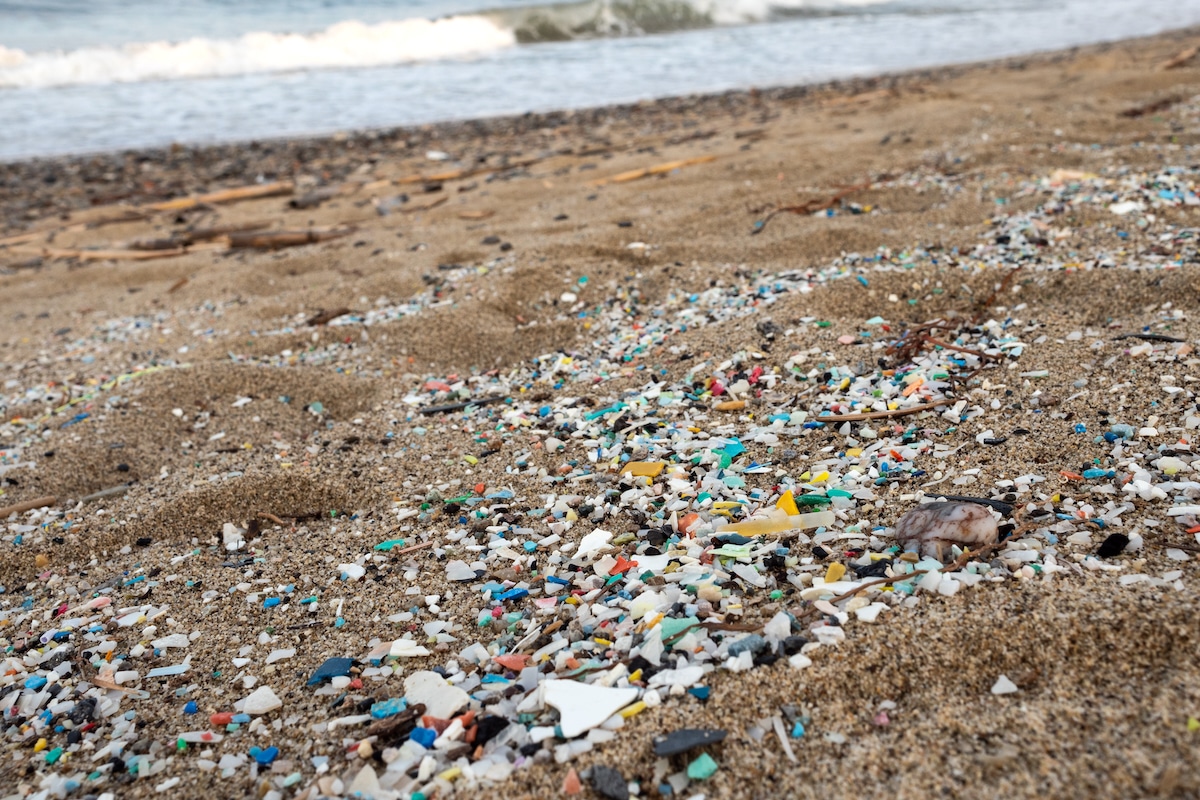
    Microplastics polluting Schiavonea Beach in Calabria, Italy
    Microplastics polluting Schiavonea Beach in Calabria, Italy. Alfonso Di Vincenzo / KONTROLAB / LightRocket via Getty Images
    Why you can trust us

    Founded in 2005 as an Ohio-based environmental newspaper, EcoWatch is a digital platform dedicated to publishing quality, science-based content on environmental issues, causes, and solutions.

    Facebook icon Twitter icon Pinterest icon Email icon

    Microplastics — tiny fragments of plastic products and industrial waste — are now so pervasive in Earth’s environment that they are found everywhere from the highest mountain peaks to the deepest parts of the ocean.

    According to a new report, all aquatic species in the mouths of rivers that flow into the Atlantic Ocean and the Mediterranean Sea are contaminated with microplastics; mollusks are the most affected because they are capable of filtering large volumes of water.

    Rivers are a main source of microplastics and nanoplastics pollution in the world’s oceans, according to the Universitat Autònoma de Barcelona (UAB). Microplastics are plastic pieces that range from 0.0001 to 5 millimeters, while nanoplastics are those smaller than 0.0001 millimeters.

    Microplastics are prevalent in the waters and sediments of estuaries, where a freshwater stream or river meets the ocean. Chemicals can be retained by these tiny plastic particles and threaten aquatic ecosystems when animals ingest them.

    “Pollution is ubiquitous in estuaries and their adjacent coasts, in the Mediterranean, and in tropical and temperate zones,” said Patrizia Ziveri, oceanographer at Institute of Environmental Science and Technology of the Universitat Autònoma de Barcelona (ICTA-UAB) and coordinator of the international project “i-plastic,” which analyzed the presence of these plastics in estuaries and adjacent coastlines, reported UAB. Ziveri pointed out that the number of sedimentary particles has increased in recent times, alongside global plastics production. In fact, since 2000, the amount of particles deposited on the ocean floor has tripled.

    The findings of the i-plastic project were that 53 percent of oysters and 85 percent of mussels had ingested microplastics. Of marine fishes dependent on estuaries, such as white mullet, Brazilian mojarra and silver mojarra, 75 percent had ingested the plastic particles. In regions along the coast that were influenced by estuarine outflow, 85 percent of Norwegian lobster and 86 percent of European hake were found to have synthetic microfibers or microplastics in their stomachs.

    According to scientists, nanoplastic pollution may be an even more serious concern than microplastics and pose a greater threat to aquatic organisms, as nanoplastics are able to penetrate the cellular membrane and cause more harm to species in marine and estuarine environments, as was seen with mussels.

    More From EcoWatch
    • Sustainable Home Improvements You Can Make
    • How to Lower Your Energy Bill
    • The Best Solar Generators

    Microplastics and nanoplastics pollution poses a worldwide threat to all coral reef systems, as they cause a reduction in the growth of coral reefs.

    Microplastics pollution is especially high near outflows from wastewater treatment plants and urban centers, from which microfibers, which are the most common kind of microlitter, are discharged into estuaries.

    “Microplastics and nanoplastics are mostly formed by the fragmentation of larger plastic items. Polyethylene, one of the most common plastic polymers produced, is more susceptible to surface oxidation, the first step in the fragmentation process. Investigating these processes under different environmental conditions is of paramount importance because they can suggest the types of synthetic polymers that are less prone to fragment into microplastics,” the report said.

    Once they are trapped in the seabed, these plastic particles do not degrade from exposure to oxygen, erosion or light.

    “Plastics from the 1960s still remain on the seabed, leaving the signature of human pollution,” said project coordinator Michael Grelaud, who is also an ICTA-UAB oceanographer.

    Particles that do not settle on the seafloor could be transported by ocean tides and currents many miles in only a few months.

    “A microplastic from the Ebro estuary in the Northwestern Mediterranean Sea can reach Sicily, in Italy, in six months,” Ziveri said.

    Filter-feeders of various species were able to remove nearly 90 percent of microplastics found in surrounding waters, according to lab experiments. The researchers emphasized that using living organisms to remove pollutants from the water, known as “bioremediation,” is one of the only viable options for reducing microplastic pollution found in coastal marine environments.

    Subscribe to get exclusive updates in our daily newsletter!

      By signing up, you agree to the Terms of Use and Privacy Policy, and to receive electronic communications from EcoWatch Media Group, which may include marketing promotions, advertisements and sponsored content.

      Cristen Hemingway Jaynes

      Cristen is a writer of fiction and nonfiction. She holds a JD and an Ocean & Coastal Law Certificate from University of Oregon School of Law and an MA in Creative Writing from Birkbeck, University of London. She is the author of the short story collection The Smallest of Entryways, as well as the travel biography, Ernest’s Way: An International Journey Through Hemingway’s Life.
      Facebook icon Twitter icon Pinterest icon Email icon

      Read More

      Methane 101: Understanding the Second Most Important Greenhouse Gas
      By Olivia Rosane and Cristen Hemingway Jaynes
      By EcoWatch
      Deepest-Known Animal Communities Found Almost Six Miles Below Sea Level
      Thousands of mollusks and worms have been discovered by a
      By Cristen Hemingway Jaynes
      Probiotic Found to Slow Disease Spread Among Florida Coral
      A beneficial bacterial probiotic is restoring hope for mitigating disease
      By Paige Bennett

      Subscribe to get exclusive updates in our daily newsletter!

        By signing up, you agree to the Terms of Use and Privacy Policy, and to receive electronic communications from EcoWatch Media Group, which may include marketing promotions, advertisements and sponsored content.

        Latest Articles

        • Methane 101: Understanding the Second Most Important Greenhouse Gas
          by EcoWatch
          August 5, 2025
        • New York Finalizes Rule for New Buildings to Be Electric
          by Paige Bennett
          August 4, 2025
        • Mass Die-Off of Western Monarch Butterflies Linked to Pesticides, Study Finds
          by Paige Bennett
          August 1, 2025
        • Deepest-Known Animal Communities Found Almost Six Miles Below Sea Level
          by Cristen Hemingway Jaynes
          August 1, 2025
        • Pristine Forest and Endangered Gorilla Habitat at Risk as Half of DRC Opened to Bids for Oil and Gas Drilling: Report
          by Cristen Hemingway Jaynes
          July 31, 2025
        • Global Hunger Fell Overall in 2024, but Rose in Africa and Western Asia as Climate and Conflict Threaten Progress: UN Report
          by Cristen Hemingway Jaynes
          July 30, 2025
        • Probiotic Found to Slow Disease Spread Among Florida Coral
          by Paige Bennett
          July 29, 2025
        • Earth Overshoot Day Reaches Record for Earliest Date
          by Paige Bennett
          July 28, 2025
        EcoWatch

        The best of EcoWatch right in your inbox. Sign up for our email newsletter!

          • Climate Climate
          • Animals Animals
          • Health + Wellness Health + Wellness
          • Insights + Opinion Insights + Opinion
          • Adventure Adventure
          • Oceans Oceans
          • Business Business
          • Solar Solar
          • About EcoWatch
          • Contact EcoWatch
          • EcoWatch Reviews
          • Terms of Use
          • Privacy Policy
          • Learn About Solar Energy
          • Learn About Deregulated Energy
          • EcoWatch UK
          Follow Us
          Facebook 558k
          Twitter 222k
          Instagram 52k
          Subscribe Subscribe

          Experts for a healthier planet and life.

          Mentioned by:
          Learn more
          • Privacy Policy
          • Terms of Use
          • Your Privacy Choices California Consumer Privacy Act (CCPA) Opt-Out Icon
          © 2026 EcoWatch. All Rights Reserved.

          Advertiser Disclosure

          Our editorial team is committed to creating independent and objective content focused on helping our readers make informed decisions. To help support these efforts we receive compensation from companies that advertise with us.

          The compensation we receive from these companies may impact how and where products appear on this site. This compensation does not influence the recommendations or advice our editorial team provides within our content. We do not include all companies, products or offers that may be available.