

EcoWatch
Facebook 558k Twitter 222k Instagram 52k Subscribe Subscribe
  • Climate
  • Energy
  • Conservation
  • Food + Agriculture
  • Renewables
  • Oceans
  • Policy
  • Insights + Opinion
  • Go Solar Today
      • Top Companies By State
        • California Solar Companies
        • Texas Solar Companies
        • New York Solar Companies
        • Florida Solar Companies
        • See All States
      • Top Incentives By State
        • California Solar Incentives
        • Texas Solar Incentives
        • New York Solar Incentives
        • Florida Solar Incentives
        • See All States
      • Solar Panel Costs By State
        • Solar Panel Costs in California
        • Solar Panel Costs in Texas
        • Solar Panel Costs in New York
        • Solar Panel Costs in Florida
        • See All States
      • Value of Solar by State
        • Is Solar Worth It In California?
        • Is Solar Worth It in Texas?
        • Is Solar Worth It New York?
        • Is Solar Worth It In Florida?
        • See All States
      • Company Reviews
        • Tesla Solar Review
        • Sunrun Solar Review
        • SunPower Solar Review
        • Vivint Solar Review
        • See All Companies
      • Common Solar Questions
        • Can You Get Free Solar Panels?
        • Does Solar Increase Home Value?
        • What’re The Best Solar Batteries?
        • Can You Finance Solar?
        • Where To Buy Solar Panels?
        • Payback On Solar Panels?
      • Solar Resources
        • Interactive Solar Calculator
        • Federal Solar Tax Credit
        • Best Solar Panels For Most Homes
        • Tesla Solar Roof Review
        • Cheapest Solar Panels
      • Companies Compared
        • SunPower vs Tesla Solar
        • SunRun vs Tesla Solar
        • SunRun vs SunPower
        • SunPower vs Momentum Solar
        • SunPower vs ADT Solar
EcoWatch
  • Climate
  • Energy
  • Conservation
  • Food + Agriculture
  • Renewables
  • Oceans
  • Policy
  • Insights + Opinion
  • Go Solar Today
    • Go Solar Today
    • Top Companies By State
      • California Solar Companies
      • Texas Solar Companies
      • New York Solar Companies
      • Florida Solar Companies
      • See All States
    • Top Incentives By State
      • California Solar Incentives
      • Texas Solar Incentives
      • New York Solar Incentives
      • Florida Solar Incentives
      • See All States
    • Solar Panel Costs By State
      • Solar Panel Costs in California
      • Solar Panel Costs in Texas
      • Solar Panel Costs in New York
      • Solar Panel Costs in Florida
      • See All States
    • Value of Solar by State
      • Is Solar Worth It In California?
      • Is Solar Worth It in Texas?
      • Is Solar Worth It New York?
      • Is Solar Worth It In Florida?
      • See All States
    • Company Reviews
      • Tesla Solar Review
      • Sunrun Solar Review
      • SunPower Solar Review
      • Vivint Solar Review
      • See All Companies
    • Common Solar Questions
      • Can You Get Free Solar Panels?
      • Does Solar Increase Home Value?
      • What’re The Best Solar Batteries?
      • Can You Finance Solar?
      • Where To Buy Solar Panels?
      • Payback On Solar Panels?
    • Solar Resources
      • Interactive Solar Calculator
      • Federal Solar Tax Credit
      • Best Solar Panels For Most Homes
      • Tesla Solar Roof Review
      • Cheapest Solar Panels
    • Companies Compared
      • SunPower vs Tesla Solar
      • SunRun vs Tesla Solar
      • SunRun vs SunPower
      • SunPower vs Momentum Solar
      • SunPower vs ADT Solar

The best of EcoWatch right in your inbox. Sign up for our email newsletter!

    • About EcoWatch
    • Contact EcoWatch
    • Terms of Use
    • Privacy Policy
    • Learn About Solar Energy
    Facebook 558k Twitter 222k Instagram 52k
    EcoWatch
    • About EcoWatch
    • Contact EcoWatch
    • Terms of Use
    • Privacy Policy
    • Learn About Solar Energy
    Facebook 558k Twitter 222k Instagram 52k
    Home Science

    DNA From Paw Prints in the Snow Could Help Monitor Polar Bears and Other Threatened Animals

    By: Cristen Hemingway Jaynes
    Published: December 4, 2023
    Edited by Chris McDermott
    Facebook icon Twitter icon Pinterest icon Email icon
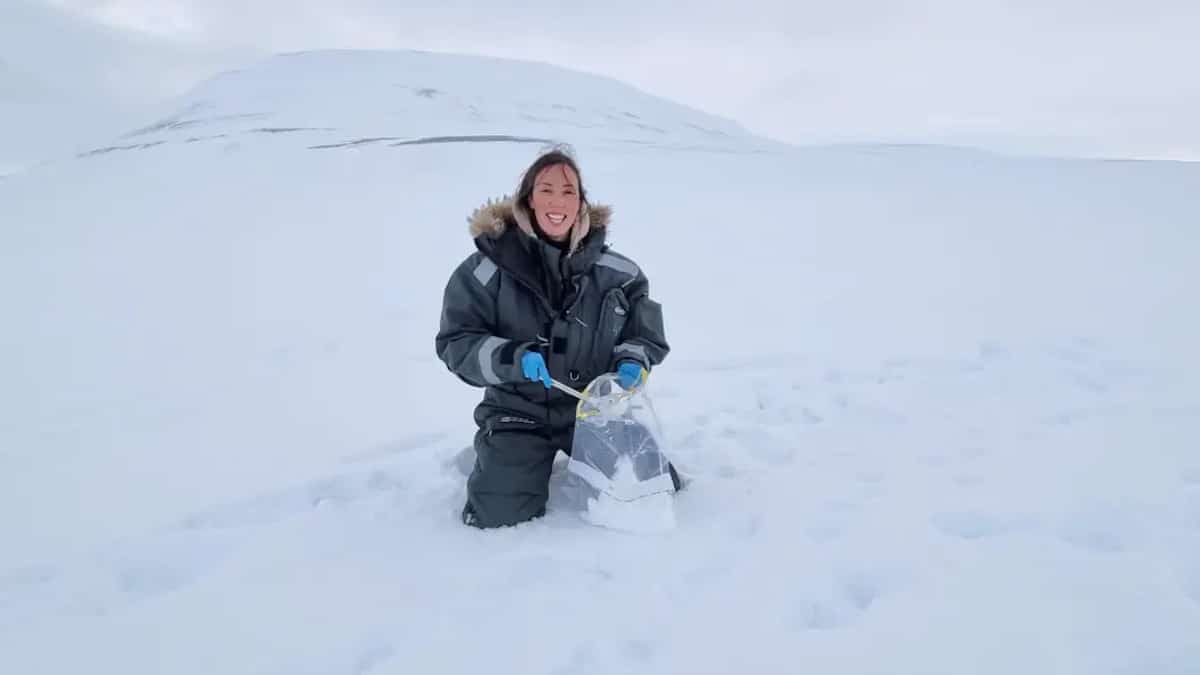
    Dr. Melanie Lancaster of the World Wide Fund for Nature Global Arctic Programme collects snow containing paw prints at Svalbard, Norway
    Dr. Melanie Lancaster of the World Wide Fund for Nature Global Arctic Programme collects snow containing paw prints at Svalbard, Norway. Micaela Hellstrom / MIX Research Sweden AB
    Why you can trust us

    Founded in 2005 as an Ohio-based environmental newspaper, EcoWatch is a digital platform dedicated to publishing quality, science-based content on environmental issues, causes, and solutions.

    Facebook icon Twitter icon Pinterest icon Email icon

    Polar bears can be elusive and difficult to track in the wild, but scientists have come up with a new, noninvasive way to follow them — as well as other animals like snow leopards and Eurasian lynxes — using environmental DNA (eDNA) extracted from skin cells shed inside their paw prints in the snow.

    Monitoring the detailed movements of polar bear populations and other threatened species is essential for their protection and conservation. However, since they can be hard to find, crucial data regarding population size and connectivity between populations has been missing, according to a new study by the World Wildlife Fund (WWF) and MIX Research Sweden AB.

    “It is particularly challenging, expensive, and time-consuming to find polar bears in the Arctic, let alone count them and understand how they are coping with climate change,” said Dr. Melanie Lancaster, senior author of the study who is also Arctic species senior specialist for the World Wide Fund for Nature Global Arctic Programme, as Frontiers reported.
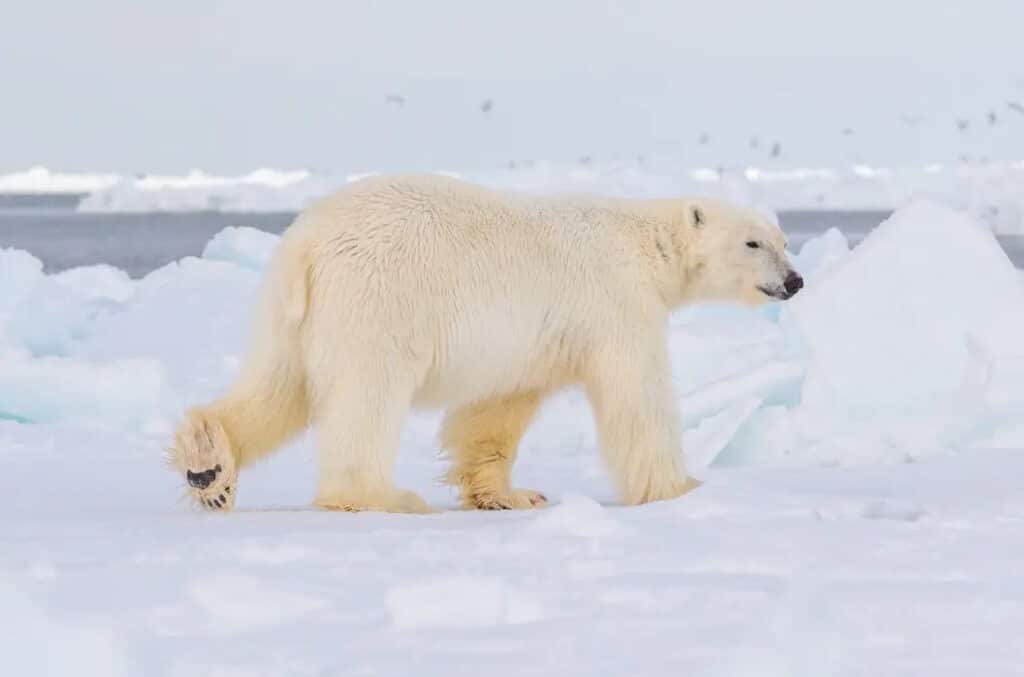
    A Polar bear near Utqiagvik, Alaska. Elisabeth Kruger / World Wildlife Fund

    The scientists at the MIX Research lab were able to isolate and sequence eDNA from the nuclei of bears’ cells left behind in their paw prints, which allowed the researchers to put together a unique genetic profile for each bear, a press release from WWF said. This will enable further understanding of behavioral and migratory patterns, as well as population interconnectedness.

    The study, “Capturing environmental DNA in snow tracks of polar bear, Eurasian lynx and snow leopard towards individual identification,” was published in the journal Frontiers in Conservation Science.

    The researchers were inspired in their data collection by forensic methods which can be used with tiny samples of DNA even when they have been degraded, reported Frontiers.

    The techniques enable scientists to study bears without physically capturing them, which is a concern for some Indigenous communities and is also stressful and dangerous for bears and humans.

    “Many Inuit express concern about invasive research methods,” said Elisabeth Kruger, co-author of the study and manager of WWF’s Arctic Wildlife Program, as Frontiers reported. “People are concerned about the welfare of the individual polar bear and the health and safety of people who may harvest the bear later. This is one of the reasons we are so excited about new methods like this – the person collecting the sample never needs to even see or be seen by the polar bear.”

    Environmental DNA can be found when animals defecate, but that form of eDNA isn’t always of a good enough quality to do the individual analysis necessary for conservation.

    More From EcoWatch
    • What Is Google Project Sunroof?
    • What Is Solar Energy & How Does it Work?
    • How to Fix Underperforming Solar Panels

    The behavior of territorial animals like snow leopards and lynxes can also be affected by collecting feces samples, so the research team opted for samples from their snowy paw prints instead.

    “The tracks usually contain fresh cells, and the DNA is intact because of the cold ‘storage’ temperature. DNA that has passed the gut is much more degraded and therefore more challenging to work on,” said lead author of the study Dr. Micaela Hellström of MIX Research Sweden, as reported by Frontiers.

    The team collected snow samples from tracks made by individual polar bears in Alaska and Eurasian lynxes in Sweden both in the wild and in captivity, as well as from tracks of a snow leopard in captivity. They also sampled materials like saliva, hair and mucus, which confirmed that the tracks were giving them accurate genotypes.

    A total of 24 tracks from wild polar bears and 44 from wild lynx were sampled by the researchers. In order to collect the eDNA, they melted then filtered snow before conducting a microsatellite analysis. Despite the fact that concentrations of eDNA were low, the research team was able to successfully extract nuclear DNA from 59.1 percent of the wild lynx tracks and 87.5 percent of those made by the wild polar bears. Of the samples from wild polar bears, 13 were able to be genotyped, which allowed for the identification of 12 distinct individuals.

    Eleven percent of the wild lynx tracks were able to be genotyped, but this number rose to 76 percent when the researchers looked only at the tracks that had been sampled by trained personnel. Of those, 24 percent were able to be genotyped.

    The new method of collecting eDNA has great potential for understanding the behavior and populations of these exquisite yet elusive animals, while also informing conservation and managing human-wildlife conflicts through the use of accurate animal identification. Even though the sampling technique has a lower success rate, the fact that it is noninvasive means sample sizes can be greatly expanded.

    “We hope this method will be taken up by the polar bear research community, with the involvement of hunters, volunteers, and Indigenous communities, as a new way to collect information on polar bears,” Lancaster said, as Frontiers reported. “We also hope the method will be expanded to other animals living in snowy environments — we have shown it works for lynx and snow leopards as a start.”

    Subscribe to get exclusive updates in our daily newsletter!

      By signing up, you agree to the Terms of Use and Privacy Policy, and to receive electronic communications from EcoWatch Media Group, which may include marketing promotions, advertisements and sponsored content.

      Cristen Hemingway Jaynes

      Cristen is a writer of fiction and nonfiction. She holds a JD and an Ocean & Coastal Law Certificate from University of Oregon School of Law and an MA in Creative Writing from Birkbeck, University of London. She is the author of the short story collection The Smallest of Entryways, as well as the travel biography, Ernest’s Way: An International Journey Through Hemingway’s Life.
      Facebook icon Twitter icon Pinterest icon Email icon

      Read More

      Methane 101: Understanding the Second Most Important Greenhouse Gas
      By Olivia Rosane and Cristen Hemingway Jaynes
      By EcoWatch
      New York Finalizes Rule for New Buildings to Be Electric
      New York is now the first state in the U.S.
      By Paige Bennett
      Mass Die-Off of Western Monarch Butterflies Linked to Pesticides, Study Finds
      A new peer-reviewed study has linked pesticides as a likely
      By Paige Bennett

      Subscribe to get exclusive updates in our daily newsletter!

        By signing up, you agree to the Terms of Use and Privacy Policy, and to receive electronic communications from EcoWatch Media Group, which may include marketing promotions, advertisements and sponsored content.

        Latest Articles

        • Methane 101: Understanding the Second Most Important Greenhouse Gas
          by EcoWatch
          August 5, 2025
        • New York Finalizes Rule for New Buildings to Be Electric
          by Paige Bennett
          August 4, 2025
        • Mass Die-Off of Western Monarch Butterflies Linked to Pesticides, Study Finds
          by Paige Bennett
          August 1, 2025
        • Deepest-Known Animal Communities Found Almost Six Miles Below Sea Level
          by Cristen Hemingway Jaynes
          August 1, 2025
        • Pristine Forest and Endangered Gorilla Habitat at Risk as Half of DRC Opened to Bids for Oil and Gas Drilling: Report
          by Cristen Hemingway Jaynes
          July 31, 2025
        • Global Hunger Fell Overall in 2024, but Rose in Africa and Western Asia as Climate and Conflict Threaten Progress: UN Report
          by Cristen Hemingway Jaynes
          July 30, 2025
        • Probiotic Found to Slow Disease Spread Among Florida Coral
          by Paige Bennett
          July 29, 2025
        • Earth Overshoot Day Reaches Record for Earliest Date
          by Paige Bennett
          July 28, 2025
        EcoWatch

        The best of EcoWatch right in your inbox. Sign up for our email newsletter!

          • Climate Climate
          • Animals Animals
          • Health + Wellness Health + Wellness
          • Insights + Opinion Insights + Opinion
          • Adventure Adventure
          • Oceans Oceans
          • Business Business
          • Solar Solar
          • About EcoWatch
          • Contact EcoWatch
          • EcoWatch Reviews
          • Terms of Use
          • Privacy Policy
          • Learn About Solar Energy
          • Learn About Deregulated Energy
          • EcoWatch UK
          Follow Us
          Facebook 558k
          Twitter 222k
          Instagram 52k
          Subscribe Subscribe

          Experts for a healthier planet and life.

          Mentioned by:
          Learn more
          • Privacy Policy
          • Terms of Use
          • Your Privacy Choices California Consumer Privacy Act (CCPA) Opt-Out Icon
          © 2026 EcoWatch. All Rights Reserved.

          Advertiser Disclosure

          Our editorial team is committed to creating independent and objective content focused on helping our readers make informed decisions. To help support these efforts we receive compensation from companies that advertise with us.

          The compensation we receive from these companies may impact how and where products appear on this site. This compensation does not influence the recommendations or advice our editorial team provides within our content. We do not include all companies, products or offers that may be available.