

EcoWatch
Facebook 558k Twitter 222k Instagram 52k Subscribe Subscribe
  • Climate
  • Energy
  • Conservation
  • Food + Agriculture
  • Renewables
  • Oceans
  • Policy
  • Insights + Opinion
  • Go Solar Today
      • Top Companies By State
        • California Solar Companies
        • Texas Solar Companies
        • New York Solar Companies
        • Florida Solar Companies
        • See All States
      • Top Incentives By State
        • California Solar Incentives
        • Texas Solar Incentives
        • New York Solar Incentives
        • Florida Solar Incentives
        • See All States
      • Solar Panel Costs By State
        • Solar Panel Costs in California
        • Solar Panel Costs in Texas
        • Solar Panel Costs in New York
        • Solar Panel Costs in Florida
        • See All States
      • Value of Solar by State
        • Is Solar Worth It In California?
        • Is Solar Worth It in Texas?
        • Is Solar Worth It New York?
        • Is Solar Worth It In Florida?
        • See All States
      • Company Reviews
        • Tesla Solar Review
        • Sunrun Solar Review
        • SunPower Solar Review
        • Vivint Solar Review
        • See All Companies
      • Common Solar Questions
        • Can You Get Free Solar Panels?
        • Does Solar Increase Home Value?
        • What’re The Best Solar Batteries?
        • Can You Finance Solar?
        • Where To Buy Solar Panels?
        • Payback On Solar Panels?
      • Solar Resources
        • Interactive Solar Calculator
        • Federal Solar Tax Credit
        • Best Solar Panels For Most Homes
        • Tesla Solar Roof Review
        • Cheapest Solar Panels
      • Companies Compared
        • SunPower vs Tesla Solar
        • SunRun vs Tesla Solar
        • SunRun vs SunPower
        • SunPower vs Momentum Solar
        • SunPower vs ADT Solar
EcoWatch
  • Climate
  • Energy
  • Conservation
  • Food + Agriculture
  • Renewables
  • Oceans
  • Policy
  • Insights + Opinion
  • Go Solar Today
    • Go Solar Today
    • Top Companies By State
      • California Solar Companies
      • Texas Solar Companies
      • New York Solar Companies
      • Florida Solar Companies
      • See All States
    • Top Incentives By State
      • California Solar Incentives
      • Texas Solar Incentives
      • New York Solar Incentives
      • Florida Solar Incentives
      • See All States
    • Solar Panel Costs By State
      • Solar Panel Costs in California
      • Solar Panel Costs in Texas
      • Solar Panel Costs in New York
      • Solar Panel Costs in Florida
      • See All States
    • Value of Solar by State
      • Is Solar Worth It In California?
      • Is Solar Worth It in Texas?
      • Is Solar Worth It New York?
      • Is Solar Worth It In Florida?
      • See All States
    • Company Reviews
      • Tesla Solar Review
      • Sunrun Solar Review
      • SunPower Solar Review
      • Vivint Solar Review
      • See All Companies
    • Common Solar Questions
      • Can You Get Free Solar Panels?
      • Does Solar Increase Home Value?
      • What’re The Best Solar Batteries?
      • Can You Finance Solar?
      • Where To Buy Solar Panels?
      • Payback On Solar Panels?
    • Solar Resources
      • Interactive Solar Calculator
      • Federal Solar Tax Credit
      • Best Solar Panels For Most Homes
      • Tesla Solar Roof Review
      • Cheapest Solar Panels
    • Companies Compared
      • SunPower vs Tesla Solar
      • SunRun vs Tesla Solar
      • SunRun vs SunPower
      • SunPower vs Momentum Solar
      • SunPower vs ADT Solar

The best of EcoWatch right in your inbox. Sign up for our email newsletter!

    • About EcoWatch
    • Contact EcoWatch
    • Terms of Use
    • Privacy Policy
    • Learn About Solar Energy
    Facebook 558k Twitter 222k Instagram 52k
    EcoWatch
    • About EcoWatch
    • Contact EcoWatch
    • Terms of Use
    • Privacy Policy
    • Learn About Solar Energy
    Facebook 558k Twitter 222k Instagram 52k
    Home Animals

    Animals Return Home Following 2018 Northern California Complex Fire

    By: Cristen Hemingway Jaynes
    Published: July 21, 2023
    Edited by Chris McDermott
    Facebook icon Twitter icon Pinterest icon Email icon
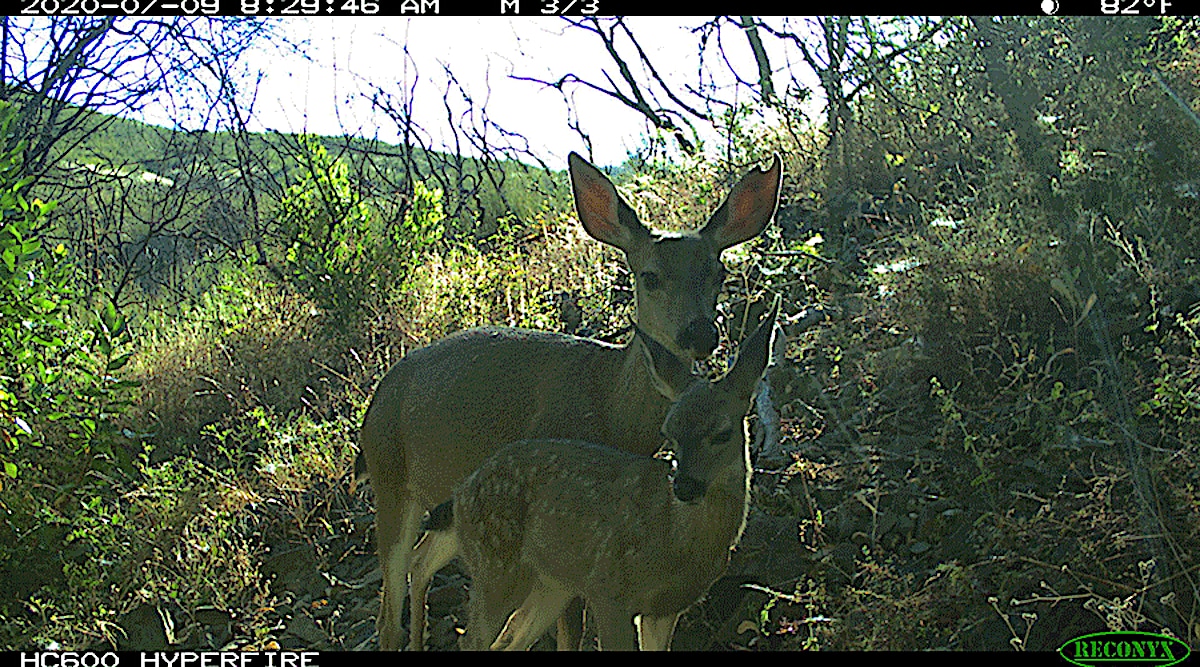
    A doe and fawn in UC’s Hopland Research and Extension Center in July 2020
    A doe and fawn in UC’s Hopland Research and Extension Center in July 2020. UC Berkeley photo courtesy Brashares Lab
    Why you can trust us

    Founded in 2005 as an Ohio-based environmental newspaper, EcoWatch is a digital platform dedicated to publishing quality, science-based content on environmental issues, causes, and solutions.

    Facebook icon Twitter icon Pinterest icon Email icon

    California’s Mendocino Complex Fire, which started in July of 2018, was composed of two separate wildfires: the Ranch Fire and the River Fire. The Ranch Fire affected more than 410,000 acres, while the River Fire impacted around 48,900 acres, according to the U.S. Bureau of Land Management.

    The massive wildfire spread quickly and burned for more than five months, destroying, among other areas, University of California’s Hopland Research and Extension Center (HREC), a multidisciplinary education and research facility just south of Ukiah on the Russian River, according to a press release from Berkeley News.

    “It felt like something out of the Lord of the Rings — like Mordor. It was hard to imagine much surviving,” said Justin Brashares, a professor of environmental science, policy and management at the University of California, Berkeley (UC Berkeley), in the press release.

    More From EcoWatch
    • Compare California Electricity Rates
    • Is California Good for Solar Energy?
    • How Well Does Solar Hold Up in Extreme Weather?

    The good news is that, just months following the fire, animals who called the ravaged Northern California habitat on either side of Clear Lake home — including gray foxes, coyotes and black-tailed jackrabbits — were spotted by motion-triggered camera traps.

    “We were surprised that many species seem to be resistant [to the impacts of the fire],” said Kendall Calhoun, a UC Berkeley graduate student and member of Brashares’ lab, in the press release.

    In order to get a feel for the impact the enormous fire had on the small- and medium-sized animals living on the HREC’s 5,300 acres, Calhoun and a team of researchers looked at more than half a million photographed grid images that had been taken there before and following the Mendocino Complex Fire.
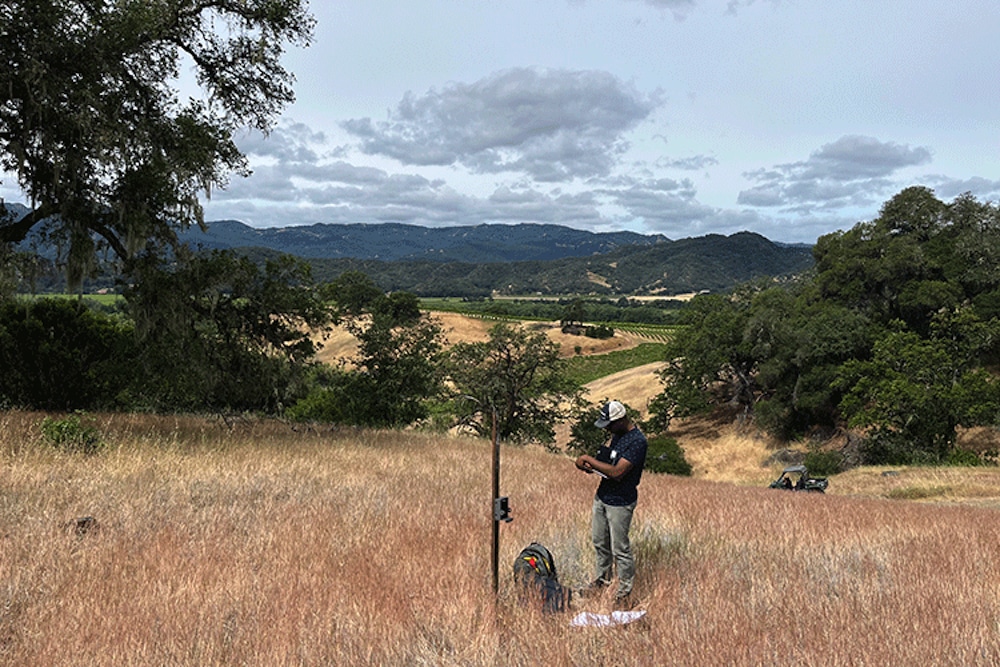
    Kendall Calhoun checks a motion-sensor camera trap located in the middle of a grassy field at Hopland Research and Extension Center. Jackie Mara Beck

    The study, “Mammalian resistance to megafire in western U.S. woodland savannas,” was published in the journal Ecosphere.

    The study was one of the first to analyze observations of wildlife preceding and after a megafire. It was also one of few studies to look specifically at how megafires affect the state’s oak woodlands. These types of ecosystems cover a large area of the state, but have not been adequately represented in research related to wildfires in comparison with Sierra Nevada’s conifer forests.

    “For the great majority of Californians, these oak woodlands and grassland savannahs are what we think of as the characteristic biome or ecosystem type for our state,” Brashares said in the press release. “It’s the primary ecosystem type for livestock grazing, and it’s also the primary habitat type that’s used to grow grapes for wine. It’s a critical ecosystem type, and it’s worth managing well.”

    The researchers studied eight animal species, and found that six were “resistant” to the fire’s impacts. These animals — racoon, gray fox, black-tailed jackrabbit, coyote, bobcat and striped skunk — used the area affected by the fire as often and in the same manner as they had before. Two species, black-tailed deer and western gray squirrel, seemed to be more susceptible to the fire’s aftermath.

    Camera trap photos showed many of the animals taking refuge in small patches of remaining tree cover — in some cases more frequently than before the fire — and the researchers thought the remaining canopy gave these species the food and resources they needed to remain.

    “Megafire had a negative effect on the detection of certain mammal species, but overall, most species showed high resistance to the disturbance and returned to detection and site use levels comparable to unburned sites by the end of the study period. Following megafire, species richness was higher in burned areas that retained higher canopy cover relative to unburned and burned sites with low canopy cover. Fire management that prevents large-scale canopy loss is critical to providing refugia for vulnerable species immediately following fire in oak woodlands, and likely other mixed-forest landscapes,” the researchers wrote in the study.

    The camera traps also took photos of apex predators like mountain lions and black bears who have home ranges often much larger than the land comprising the HREC, so an accurate idea of their distribution wasn’t possible from the study area.

    However, Calhoun said the larger animals weren’t seen nearly as often following the fire, which indicates they were not as quick to revisit the habitat affected by the megafire.

    According to the press release, the findings of the study emphasize the importance of prescribed burning and grazing in order to reduce wildfire intensity, since it is more likely that tree cover will be intact following less severe fires.

    “Even this incredibly hot and devastating fire still managed to leave behind these little patches of unburnt areas, and we were surprised at how quickly many species were able to move into those habitat patches and then spread back out into the burned areas as they recovered,” Brashares said in the press release. “This finding is very valuable for forest management because we can do things to the landscape that will increase the chance that when fire does come through, it will leave behind some of these fragments.”

    Subscribe to get exclusive updates in our daily newsletter!

      By signing up, you agree to the Terms of Use and Privacy Policy, and to receive electronic communications from EcoWatch Media Group, which may include marketing promotions, advertisements and sponsored content.

      Cristen Hemingway Jaynes

      Cristen is a writer of fiction and nonfiction. She holds a JD and an Ocean & Coastal Law Certificate from University of Oregon School of Law and an MA in Creative Writing from Birkbeck, University of London. She is the author of the short story collection The Smallest of Entryways, as well as the travel biography, Ernest’s Way: An International Journey Through Hemingway’s Life.
      Facebook icon Twitter icon Pinterest icon Email icon

      Read More

      Methane 101: Understanding the Second Most Important Greenhouse Gas
      By Olivia Rosane and Cristen Hemingway Jaynes
      By EcoWatch
      Mass Die-Off of Western Monarch Butterflies Linked to Pesticides, Study Finds
      A new peer-reviewed study has linked pesticides as a likely
      By Paige Bennett
      Pristine Forest and Endangered Gorilla Habitat at Risk as Half of DRC Opened to Bids for Oil and Gas Drilling: Report
      The Democratic Republic of the Congo (DRC) is home to
      By Cristen Hemingway Jaynes

      Subscribe to get exclusive updates in our daily newsletter!

        By signing up, you agree to the Terms of Use and Privacy Policy, and to receive electronic communications from EcoWatch Media Group, which may include marketing promotions, advertisements and sponsored content.

        Latest Articles

        • Methane 101: Understanding the Second Most Important Greenhouse Gas
          by EcoWatch
          August 5, 2025
        • New York Finalizes Rule for New Buildings to Be Electric
          by Paige Bennett
          August 4, 2025
        • Mass Die-Off of Western Monarch Butterflies Linked to Pesticides, Study Finds
          by Paige Bennett
          August 1, 2025
        • Deepest-Known Animal Communities Found Almost Six Miles Below Sea Level
          by Cristen Hemingway Jaynes
          August 1, 2025
        • Pristine Forest and Endangered Gorilla Habitat at Risk as Half of DRC Opened to Bids for Oil and Gas Drilling: Report
          by Cristen Hemingway Jaynes
          July 31, 2025
        • Global Hunger Fell Overall in 2024, but Rose in Africa and Western Asia as Climate and Conflict Threaten Progress: UN Report
          by Cristen Hemingway Jaynes
          July 30, 2025
        • Probiotic Found to Slow Disease Spread Among Florida Coral
          by Paige Bennett
          July 29, 2025
        • Earth Overshoot Day Reaches Record for Earliest Date
          by Paige Bennett
          July 28, 2025
        EcoWatch

        The best of EcoWatch right in your inbox. Sign up for our email newsletter!

          • Climate Climate
          • Animals Animals
          • Health + Wellness Health + Wellness
          • Insights + Opinion Insights + Opinion
          • Adventure Adventure
          • Oceans Oceans
          • Business Business
          • Solar Solar
          • About EcoWatch
          • Contact EcoWatch
          • EcoWatch Reviews
          • Terms of Use
          • Privacy Policy
          • Learn About Solar Energy
          • Learn About Deregulated Energy
          • EcoWatch UK
          Follow Us
          Facebook 558k
          Twitter 222k
          Instagram 52k
          Subscribe Subscribe

          Experts for a healthier planet and life.

          Mentioned by:
          Learn more
          • Privacy Policy
          • Terms of Use
          • Cookie Preferences
          • Do Not Sell My Information
          © 2025 EcoWatch. All Rights Reserved.

          Advertiser Disclosure

          Our editorial team is committed to creating independent and objective content focused on helping our readers make informed decisions. To help support these efforts we receive compensation from companies that advertise with us.

          The compensation we receive from these companies may impact how and where products appear on this site. This compensation does not influence the recommendations or advice our editorial team provides within our content. We do not include all companies, products or offers that may be available.