

EcoWatch
Facebook 558k Twitter 222k Instagram 52k Subscribe Subscribe
  • Climate
  • Energy
  • Conservation
  • Food + Agriculture
  • Renewables
  • Oceans
  • Policy
  • Insights + Opinion
  • Go Solar Today
      • Top Companies By State
        • California Solar Companies
        • Texas Solar Companies
        • New York Solar Companies
        • Florida Solar Companies
        • See All States
      • Top Incentives By State
        • California Solar Incentives
        • Texas Solar Incentives
        • New York Solar Incentives
        • Florida Solar Incentives
        • See All States
      • Solar Panel Costs By State
        • Solar Panel Costs in California
        • Solar Panel Costs in Texas
        • Solar Panel Costs in New York
        • Solar Panel Costs in Florida
        • See All States
      • Value of Solar by State
        • Is Solar Worth It In California?
        • Is Solar Worth It in Texas?
        • Is Solar Worth It New York?
        • Is Solar Worth It In Florida?
        • See All States
      • Company Reviews
        • Tesla Solar Review
        • Sunrun Solar Review
        • SunPower Solar Review
        • Vivint Solar Review
        • See All Companies
      • Common Solar Questions
        • Can You Get Free Solar Panels?
        • Does Solar Increase Home Value?
        • What’re The Best Solar Batteries?
        • Can You Finance Solar?
        • Where To Buy Solar Panels?
        • Payback On Solar Panels?
      • Solar Resources
        • Interactive Solar Calculator
        • Federal Solar Tax Credit
        • Best Solar Panels For Most Homes
        • Tesla Solar Roof Review
        • Cheapest Solar Panels
      • Companies Compared
        • SunPower vs Tesla Solar
        • SunRun vs Tesla Solar
        • SunRun vs SunPower
        • SunPower vs Momentum Solar
        • SunPower vs ADT Solar
EcoWatch
  • Climate
  • Energy
  • Conservation
  • Food + Agriculture
  • Renewables
  • Oceans
  • Policy
  • Insights + Opinion
  • Go Solar Today
    • Go Solar Today
    • Top Companies By State
      • California Solar Companies
      • Texas Solar Companies
      • New York Solar Companies
      • Florida Solar Companies
      • See All States
    • Top Incentives By State
      • California Solar Incentives
      • Texas Solar Incentives
      • New York Solar Incentives
      • Florida Solar Incentives
      • See All States
    • Solar Panel Costs By State
      • Solar Panel Costs in California
      • Solar Panel Costs in Texas
      • Solar Panel Costs in New York
      • Solar Panel Costs in Florida
      • See All States
    • Value of Solar by State
      • Is Solar Worth It In California?
      • Is Solar Worth It in Texas?
      • Is Solar Worth It New York?
      • Is Solar Worth It In Florida?
      • See All States
    • Company Reviews
      • Tesla Solar Review
      • Sunrun Solar Review
      • SunPower Solar Review
      • Vivint Solar Review
      • See All Companies
    • Common Solar Questions
      • Can You Get Free Solar Panels?
      • Does Solar Increase Home Value?
      • What’re The Best Solar Batteries?
      • Can You Finance Solar?
      • Where To Buy Solar Panels?
      • Payback On Solar Panels?
    • Solar Resources
      • Interactive Solar Calculator
      • Federal Solar Tax Credit
      • Best Solar Panels For Most Homes
      • Tesla Solar Roof Review
      • Cheapest Solar Panels
    • Companies Compared
      • SunPower vs Tesla Solar
      • SunRun vs Tesla Solar
      • SunRun vs SunPower
      • SunPower vs Momentum Solar
      • SunPower vs ADT Solar

The best of EcoWatch right in your inbox. Sign up for our email newsletter!

    • About EcoWatch
    • Contact EcoWatch
    • Terms of Use
    • Privacy Policy
    • Learn About Solar Energy
    Facebook 558k Twitter 222k Instagram 52k
    EcoWatch
    • About EcoWatch
    • Contact EcoWatch
    • Terms of Use
    • Privacy Policy
    • Learn About Solar Energy
    Facebook 558k Twitter 222k Instagram 52k
    Home Conservation

    Why You Shouldn’t Rake Your Leaves This Fall

    By: Linnea Harris
    Published: September 29, 2023
    Facebook icon Twitter icon Pinterest icon Email icon
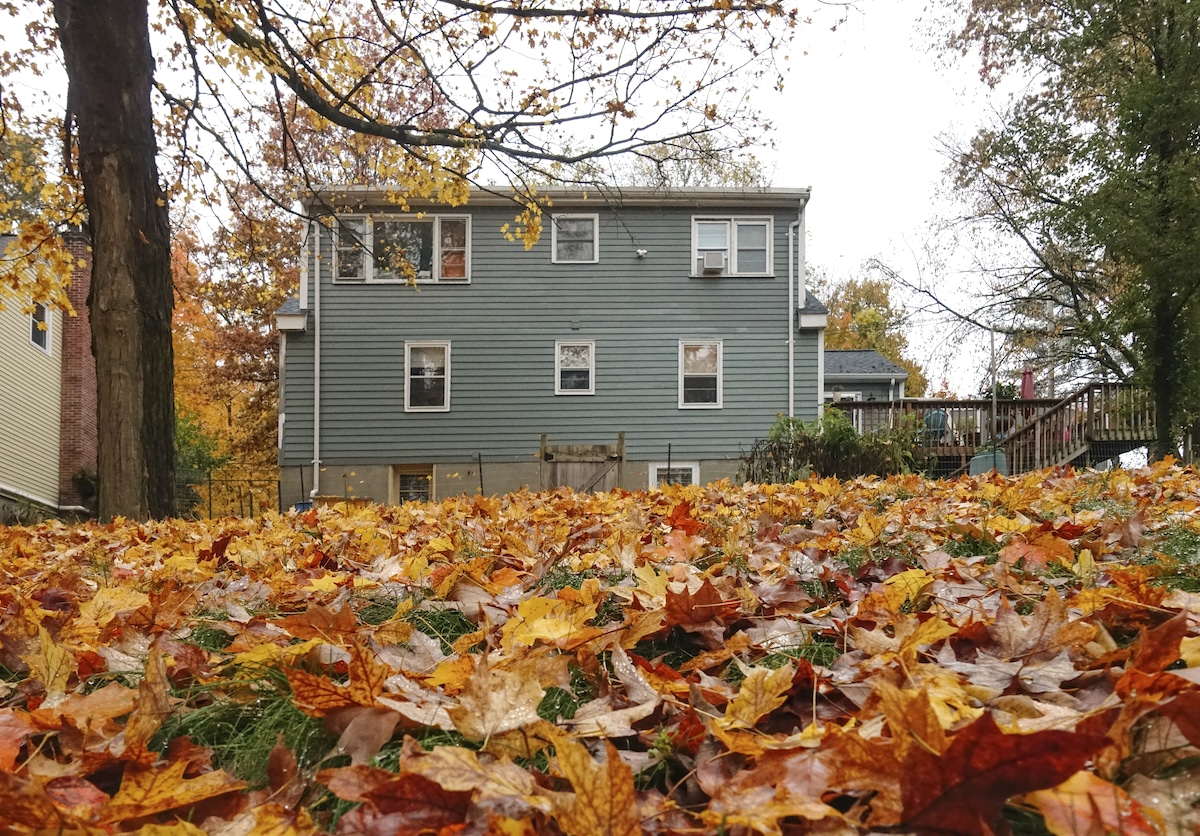
    Colorful leaves cover the yard of a house in Framingham, Massachusetts
    Autumn leaves cover a yard in Framingham, Massachusetts. EyeWolf / Moment / Getty Images
    Why you can trust us

    Founded in 2005 as an Ohio-based environmental newspaper, EcoWatch is a digital platform dedicated to publishing quality, science-based content on environmental issues, causes, and solutions.

    Facebook icon Twitter icon Pinterest icon Email icon

    The weather is getting cooler, the air is feeling crisper, the leaves are turning yellow and red falling from their trees — and this year, leave those leaves be! 

    It’s a common misconception that leaves always kill the grass they fall on. Aside from the fact that it’s time to ditch our lawns in the first place, fallen leaves are very beneficial to your soil, trees and plants, and the ecosystem of your backyard. By bagging them up and hauling them away, you are removing a valuable natural resource from your yard.  

    If you have a yard or live in a neighborhood with other tree-filled properties, you’re likely familiar with the cycle of filling up large bags of leaves and putting them on the curb to be taken away. A lot of the time, unfortunately, these leaves aren’t being composted, but are taken straight to landfills. In 2018, 10.5 million tons of yard trimmings went to landfills, which was about 7.2% of all municipal solid waste landfilled. Yard debris as a whole account for 13%. When organic matter goes into a sealed landfill, there isn’t enough oxygen for it to properly decompose. As it breaks down, it produces methane: a harmful greenhouse gas even more potent than carbon dioxide. In all, solid-waste landfills are the third-largest source of human-made methane emissions in the U.S.

    Here’s why you shouldn’t remove leaves from your yard and garden, and how to handle them instead. 

    They Deliver Nutrients Back to the Soil 

    Rather than buying fertilizer for the yard or garden, just leave the leaves be! They break down naturally over time, delivering nitrogen, phosphorus and potassium back to the soil as they do — and what gardener doesn’t want free fertilizer? This is, after all, the natural cycle that leaves take. In just one acre of temperate forest, two tons of leaves fall every autumn, which are hosts to beneficial microorganisms that break down these leaves, allowing the nutrients to be taken up by the trees again. These microbes also create a richer, healthier soil for growing your plants. By removing these leaves, we deprive trees and other growth of this important resource to sustain themselves. 

    They Sustain Wildlife Populations 

    To wildlife, fallen leaves also function as bedding and nesting material. Some animals like frogs, toads, and salamanders — depending on your region — hibernate under leaves in the winter. It also serves as a food source for insects like spiders and slugs, who are beneficial insects for your garden. Having insects means that other larger predators will come to your yard too. Caterpillars, for example, provide food for birds, thus promoting a more robust ecosystem right outside your window. Fostering a biodiverse yard will in turn help the biodiversity of your community, allowing native species to thrive and support one another in maintaining an active, healthy ecosystem: something that’s often lost when humans develop natural areas, displacing wildlife and removing their sources of food.

    They Suppress Garden Weeds and Support Soil Structure 

    Fallen leaves act like mulch, keeping down competing plants like weeds and shrubs. The leaves will also regulate the temperature of the soil and improve soil structure, making heavy soils more porous and sandier soils more able to retain and conserve moisture. If you experience a lot of compaction or erosion from rainfall in your garden, leaves will help alleviate both. Not to mention, traditional mulch can be quite expensive at garden centers. 

    How to Leave Leaves 

    Sure, you can just leave them be. But, if you want to make the most out of your leaves, here are a few ways to handle them. 

    Mow Over Leaves 

    It might seem counterintuitive to run over leaves with the mower, making an even bigger mess — but in many cases, it’s the best first step in letting leaves work their magic.  

    If the layer of leaves on your lawn is relatively thin — about an inch or less — there’s no need to move it at all — just leave them on the lawn and mow them over to kickstart decomposition, allowing the nutrients to return to the soil more quickly.  Wait until they are mostly dry before going over them with the lawnmower, a mulching mower, or a mulching attachment on a traditional mower. An extremely thick pile of leaves will trap moisture and keep out sunlight, preventing the grass from photosynthesizing, in which case one of the following methods might be more appropriate. 

    Layer the Garden

    Using leaves to layer garden beds is a good option if you have an excess amount to deal with, or you prefer not to leave them in your yard. Rake the leaves onto garden and flower beds, or around the base of trees — they’ll suppress weeds and eventually decompose to support soil. If they’re large leaves, shred them in the mower before layering. Generally, between 2-4 inches is ideal (more for trees, less for perennial plants).

    Reclaim Spent Soil 

    Growing healthy, robust plants requires healthy, robust soil — and leaf mold might be just the soil amendment you need. Just let them decompose atop a section of the yard with poor soil. The lower part of the pile will decompose well, and the top layer can be turned under the soil in the spring.

    Build a Wildlife Shelter

    Create a brush shelter in the corner of your yard, if you have space. A simple pile of branches, leaves, sticks, and other yard waste that will be helpful for overwintering insects and nesting animals in the cold winter weather.

    Other Ways to Handle Leaves 

    It isn’t always possible to let leaves decompose on your property. Maybe you don’t have room for the piles, or don’t have a large enough yard to spread them out, or rent a place that requires you to remove leaves. It is true for city-dwellers that leaves left on yards can wash into streets and clog storm drains. In that case, composting can offer a great solution. 

    Compost

    If you maintain your own at-home compost bin, you know the importance of adding brown matter to the pile. Keep a pile (or box, or bag) of leaves next to the compost or in the garage, and add it slowly to your food scraps throughout the winter. They’ll decompose even better if you shred them with the mower beforehand. 

    Compost Drop-Offs and Pick-Ups

    Sometimes, leaf pick-up services do actually take the leaves to be composted. Look into your city or municipality’s processes for handling leaves, and confirm that they will indeed be recycled. Some cities will have programs that either compost the leaves or turn them into mulch, and then offer those products back to gardeners to use. Otherwise, companies will even come and collect all of the leaves for you to be composted.

    Subscribe to get exclusive updates in our daily newsletter!

      By signing up, you agree to the Terms of Use and Privacy Policy, and to receive electronic communications from EcoWatch Media Group, which may include marketing promotions, advertisements and sponsored content.

      Linnea Harris

      Linnea graduated from Skidmore College in 2019 with a Bachelor’s degree in English and Environmental Studies, and now lives in Brooklyn, New York. Along with her most recent position at Hunger Free America, she has interned with the Sierra Club in Washington, DC., Saratoga Living Magazine, and Philadelphia’s NPR Member Station, WHYY.
      Facebook icon Twitter icon Pinterest icon Email icon

      Read More

      Methane 101: Understanding the Second Most Important Greenhouse Gas
      By Olivia Rosane and Cristen Hemingway Jaynes
      By EcoWatch
      New York Finalizes Rule for New Buildings to Be Electric
      New York is now the first state in the U.S.
      By Paige Bennett
      Mass Die-Off of Western Monarch Butterflies Linked to Pesticides, Study Finds
      A new peer-reviewed study has linked pesticides as a likely
      By Paige Bennett

      Subscribe to get exclusive updates in our daily newsletter!

        By signing up, you agree to the Terms of Use and Privacy Policy, and to receive electronic communications from EcoWatch Media Group, which may include marketing promotions, advertisements and sponsored content.

        Latest Articles

        • Methane 101: Understanding the Second Most Important Greenhouse Gas
          by EcoWatch
          August 5, 2025
        • New York Finalizes Rule for New Buildings to Be Electric
          by Paige Bennett
          August 4, 2025
        • Mass Die-Off of Western Monarch Butterflies Linked to Pesticides, Study Finds
          by Paige Bennett
          August 1, 2025
        • Deepest-Known Animal Communities Found Almost Six Miles Below Sea Level
          by Cristen Hemingway Jaynes
          August 1, 2025
        • Pristine Forest and Endangered Gorilla Habitat at Risk as Half of DRC Opened to Bids for Oil and Gas Drilling: Report
          by Cristen Hemingway Jaynes
          July 31, 2025
        • Global Hunger Fell Overall in 2024, but Rose in Africa and Western Asia as Climate and Conflict Threaten Progress: UN Report
          by Cristen Hemingway Jaynes
          July 30, 2025
        • Probiotic Found to Slow Disease Spread Among Florida Coral
          by Paige Bennett
          July 29, 2025
        • Earth Overshoot Day Reaches Record for Earliest Date
          by Paige Bennett
          July 28, 2025
        EcoWatch

        The best of EcoWatch right in your inbox. Sign up for our email newsletter!

          • Climate Climate
          • Animals Animals
          • Health + Wellness Health + Wellness
          • Insights + Opinion Insights + Opinion
          • Adventure Adventure
          • Oceans Oceans
          • Business Business
          • Solar Solar
          • About EcoWatch
          • Contact EcoWatch
          • EcoWatch Reviews
          • Terms of Use
          • Privacy Policy
          • Learn About Solar Energy
          • Learn About Deregulated Energy
          • EcoWatch UK
          Follow Us
          Facebook 558k
          Twitter 222k
          Instagram 52k
          Subscribe Subscribe

          Experts for a healthier planet and life.

          Mentioned by:
          Learn more
          • Privacy Policy
          • Terms of Use
          • Cookie Preferences
          • Do Not Sell My Information
          © 2025 EcoWatch. All Rights Reserved.

          Advertiser Disclosure

          Our editorial team is committed to creating independent and objective content focused on helping our readers make informed decisions. To help support these efforts we receive compensation from companies that advertise with us.

          The compensation we receive from these companies may impact how and where products appear on this site. This compensation does not influence the recommendations or advice our editorial team provides within our content. We do not include all companies, products or offers that may be available.