

EcoWatch
Facebook 558k Twitter 222k Instagram 52k Subscribe Subscribe
  • Climate
  • Energy
  • Conservation
  • Food + Agriculture
  • Renewables
  • Oceans
  • Policy
  • Insights + Opinion
  • Go Solar Today
      • Top Companies By State
        • California Solar Companies
        • Texas Solar Companies
        • New York Solar Companies
        • Florida Solar Companies
        • See All States
      • Top Incentives By State
        • California Solar Incentives
        • Texas Solar Incentives
        • New York Solar Incentives
        • Florida Solar Incentives
        • See All States
      • Solar Panel Costs By State
        • Solar Panel Costs in California
        • Solar Panel Costs in Texas
        • Solar Panel Costs in New York
        • Solar Panel Costs in Florida
        • See All States
      • Value of Solar by State
        • Is Solar Worth It In California?
        • Is Solar Worth It in Texas?
        • Is Solar Worth It New York?
        • Is Solar Worth It In Florida?
        • See All States
      • Company Reviews
        • Tesla Solar Review
        • Sunrun Solar Review
        • SunPower Solar Review
        • Vivint Solar Review
        • See All Companies
      • Common Solar Questions
        • Can You Get Free Solar Panels?
        • Does Solar Increase Home Value?
        • What’re The Best Solar Batteries?
        • Can You Finance Solar?
        • Where To Buy Solar Panels?
        • Payback On Solar Panels?
      • Solar Resources
        • Interactive Solar Calculator
        • Federal Solar Tax Credit
        • Best Solar Panels For Most Homes
        • Tesla Solar Roof Review
        • Cheapest Solar Panels
      • Companies Compared
        • SunPower vs Tesla Solar
        • SunRun vs Tesla Solar
        • SunRun vs SunPower
        • SunPower vs Momentum Solar
        • SunPower vs ADT Solar
EcoWatch
  • Climate
  • Energy
  • Conservation
  • Food + Agriculture
  • Renewables
  • Oceans
  • Policy
  • Insights + Opinion
  • Go Solar Today
    • Go Solar Today
    • Top Companies By State
      • California Solar Companies
      • Texas Solar Companies
      • New York Solar Companies
      • Florida Solar Companies
      • See All States
    • Top Incentives By State
      • California Solar Incentives
      • Texas Solar Incentives
      • New York Solar Incentives
      • Florida Solar Incentives
      • See All States
    • Solar Panel Costs By State
      • Solar Panel Costs in California
      • Solar Panel Costs in Texas
      • Solar Panel Costs in New York
      • Solar Panel Costs in Florida
      • See All States
    • Value of Solar by State
      • Is Solar Worth It In California?
      • Is Solar Worth It in Texas?
      • Is Solar Worth It New York?
      • Is Solar Worth It In Florida?
      • See All States
    • Company Reviews
      • Tesla Solar Review
      • Sunrun Solar Review
      • SunPower Solar Review
      • Vivint Solar Review
      • See All Companies
    • Common Solar Questions
      • Can You Get Free Solar Panels?
      • Does Solar Increase Home Value?
      • What’re The Best Solar Batteries?
      • Can You Finance Solar?
      • Where To Buy Solar Panels?
      • Payback On Solar Panels?
    • Solar Resources
      • Interactive Solar Calculator
      • Federal Solar Tax Credit
      • Best Solar Panels For Most Homes
      • Tesla Solar Roof Review
      • Cheapest Solar Panels
    • Companies Compared
      • SunPower vs Tesla Solar
      • SunRun vs Tesla Solar
      • SunRun vs SunPower
      • SunPower vs Momentum Solar
      • SunPower vs ADT Solar

The best of EcoWatch right in your inbox. Sign up for our email newsletter!

    • About EcoWatch
    • Contact EcoWatch
    • Terms of Use
    • Privacy Policy
    • Learn About Solar Energy
    Facebook 558k Twitter 222k Instagram 52k
    EcoWatch
    • About EcoWatch
    • Contact EcoWatch
    • Terms of Use
    • Privacy Policy
    • Learn About Solar Energy
    Facebook 558k Twitter 222k Instagram 52k
    Home Climate

    Sea Level Rise Will Affect 4 Out of 5 Miami Residents, Even Those Living Outside of Flood Zones, Study Says

    By: Cristen Hemingway Jaynes
    Published: October 17, 2023
    Edited by Chris McDermott
    Facebook icon Twitter icon Pinterest icon Email icon
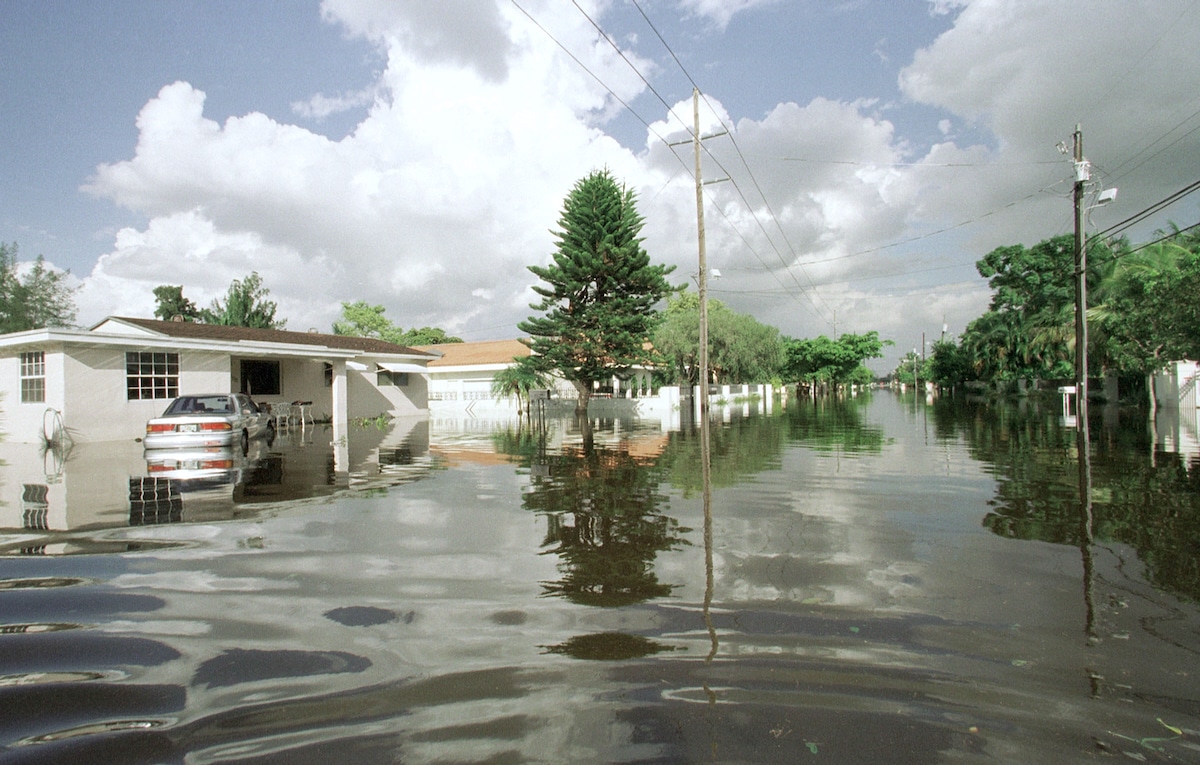
    Residential streets flooded with more than a foot of water in Miami, Florida after a tropical depression
    Streets flooded with more than a foot of water in Miami, Florida after a tropical depression, on Oct. 5, 2000. Robert King / Newsmakers
    Why you can trust us

    Founded in 2005 as an Ohio-based environmental newspaper, EcoWatch is a digital platform dedicated to publishing quality, science-based content on environmental issues, causes, and solutions.

    Facebook icon Twitter icon Pinterest icon Email icon

    Sea-level rise due to climate change is becoming an increasing concern for island nations and low-lying areas, such as Miami-Dade County, Florida.

    The primary focus of research on sea-level rise has been the direct effects of flooding, but a new study also considers socioeconomic vulnerabilities.

    The study found that, in the coming decades, four out of five Miami-Dade County residents could face displacement or disruption due to sea-level rise, whether or not they live in a flood zone, a press release from the Lamont-Doherty Earth Observatory at Columbia Climate School said.

    More From EcoWatch
    • Do Florida Solar Incentives Make It Affordable for Homeowners to Go Solar?
    • The Best Solar-Powered Water Pumps
    • How Well Does Solar Hold Up in Extreme Weather?

    The researchers concluded that, as inundation increases, lower-income residents will bear the brunt of a lack of habitable areas and skyrocketing housing prices. A small percentage of affluent residents will have the means to move from waterfront or low-lying properties, but others may have no choice but to stay, according to the study.

    “Most studies focus on the direct effects of inundation,” said Nadia Seeteram, lead author of the study and a postdoctoral researcher at Columbia’s Lamont-Doherty Earth Observatory, in the press release. “Here, we were able to look at flooding on a very granular level, and add in other vulnerabilities.”

    The study, “Modes of climate mobility under sea-level rise,” was published in the journal Environmental Research Letters.

    The researchers looked at a combination of rainfall, storm surge and projections of flooding caused directly by sea-level rise that went from building to building, as well as demographic data, in determining the effects on residents, the press release said.

    The team used data from the U.S. Census Bureau along with flood maps to chart the social and economic factors that would lead to residents being more or less vulnerable. These included age, income, employment status, race, education level, whether they were homeowners or renters and other factors.

    The population was then divided into four categories. The first and most common were those residents facing sea-level rise of one meter, considered a “middle-of-the-road” possibility by the year 2100. This scenario would affect 56 percent of residents who live mostly on higher ground. The researchers called this portion of the population “displaced,” saying they could be faced with pressure to relocate.

    The next most common group — 19 percent — were those living in perpetually flooded areas without the means to move to higher ground. The research team called this portion of the population “trapped.”

    Another 19 percent of residents were those considered “stable” because they lived in areas that weren’t prone to flooding and were able to stay.

    The wealthiest percentage of the population, the seven percent the team called “migrating,” would be subjected to flooding in low-lying or waterfront areas, but would be able to relocate to safer metro area locations.

    “However, social and economic risks may extend to communities substantially beyond flooded areas as the spatiotemporal dynamics of flood risks are realized through housing markets, insurance and risk-transfer mechanisms, and adaptation investments,” the study said. “Notably ‘climate gentrification’ and affordable housing shortages can result from increasing demand for housing in safer areas. Furthermore, disaster-related displacement and declining property values and household wealth from [sea-level rise] and extreme flooding have the potential to exacerbate existing social inequity.”

    The research team said that beyond a meter of sea-level rise would mean direct flooding, rather than economic pressures, would become the main factor affecting the population.

    Two meters — a “fairly high” estimate — would cause inundation for more than half the population from more rainfall and sea-level rise. This would lead to 49 percent of residents becoming trapped and a quarter displaced. Just eight percent would be classed as stable.

    “This is where it gets to be more drastic, more existential,” Seeteram said in the press release.

    Seeteram said both scenarios would mean the potential for depopulation and devaluation of flooded properties. This could make it harder for tax collection by authorities to fund infrastructure adaptation to hold back flood waters.

    Flooding is already a routine occurrence in the area, as rain collects in the streets and high tides come up through sewers. Seeteram said during the wet season from May to October, flash flooding is common.

    Signs of climate gentrification have already begun, with property values and development in a neighborhood 10 lofty feet above sea level called Little Haiti soaring. The predominantly Black residents of the neighborhood fear they may be forced to move.

    “I suspect it is already happening,” said co-author of the study Katharine Mach, who is University of Miami’s chair of the Department of Environmental Science and Policy, in the press release.

    Mach said other factors may be more responsible for changing real-estate values at the moment, such as already established pro-development policies.

    “The question is, what fraction [of rising prices] can you put on climate?” Mach said.

    Mach added that waterfront and low-lying areas are seeing increased real-estate prices, while locations less prone to flooding aren’t going up as quickly, which may indicate that buyers’ decisions are being affected by predicted rises in sea levels.

    Seteeram said the study’s projections might not happen, but it depends on how the city deals with these issues in the future. The effects of sea-level rise could be tempered with measures like infrastructure modification.

    “We could see different kinds of housing development, to make the population denser in some areas, or more climate resilient. But then you would have to see what the intersection would be with affordability for a lot of people,” Seteeram said in the press release.

    Subscribe to get exclusive updates in our daily newsletter!

      By signing up, you agree to the Terms of Use and Privacy Policy, and to receive electronic communications from EcoWatch Media Group, which may include marketing promotions, advertisements and sponsored content.

      Cristen Hemingway Jaynes

      Cristen is a writer of fiction and nonfiction. She holds a JD and an Ocean & Coastal Law Certificate from University of Oregon School of Law and an MA in Creative Writing from Birkbeck, University of London. She is the author of the short story collection The Smallest of Entryways, as well as the travel biography, Ernest’s Way: An International Journey Through Hemingway’s Life.
      Facebook icon Twitter icon Pinterest icon Email icon

      Read More

      Methane 101: Understanding the Second Most Important Greenhouse Gas
      By Olivia Rosane and Cristen Hemingway Jaynes
      By EcoWatch
      Pristine Forest and Endangered Gorilla Habitat at Risk as Half of DRC Opened to Bids for Oil and Gas Drilling: Report
      The Democratic Republic of the Congo (DRC) is home to
      By Cristen Hemingway Jaynes
      UN’s Top Court Rules That ‘Clean, Healthy’ Environment Is a Human Right
      In a landmark finding, the United Nations’ top court on
      By Cristen Hemingway Jaynes

      Subscribe to get exclusive updates in our daily newsletter!

        By signing up, you agree to the Terms of Use and Privacy Policy, and to receive electronic communications from EcoWatch Media Group, which may include marketing promotions, advertisements and sponsored content.

        Latest Articles

        • Methane 101: Understanding the Second Most Important Greenhouse Gas
          by EcoWatch
          August 5, 2025
        • New York Finalizes Rule for New Buildings to Be Electric
          by Paige Bennett
          August 4, 2025
        • Mass Die-Off of Western Monarch Butterflies Linked to Pesticides, Study Finds
          by Paige Bennett
          August 1, 2025
        • Deepest-Known Animal Communities Found Almost Six Miles Below Sea Level
          by Cristen Hemingway Jaynes
          August 1, 2025
        • Pristine Forest and Endangered Gorilla Habitat at Risk as Half of DRC Opened to Bids for Oil and Gas Drilling: Report
          by Cristen Hemingway Jaynes
          July 31, 2025
        • Global Hunger Fell Overall in 2024, but Rose in Africa and Western Asia as Climate and Conflict Threaten Progress: UN Report
          by Cristen Hemingway Jaynes
          July 30, 2025
        • Probiotic Found to Slow Disease Spread Among Florida Coral
          by Paige Bennett
          July 29, 2025
        • Earth Overshoot Day Reaches Record for Earliest Date
          by Paige Bennett
          July 28, 2025
        EcoWatch

        The best of EcoWatch right in your inbox. Sign up for our email newsletter!

          • Climate Climate
          • Animals Animals
          • Health + Wellness Health + Wellness
          • Insights + Opinion Insights + Opinion
          • Adventure Adventure
          • Oceans Oceans
          • Business Business
          • Solar Solar
          • About EcoWatch
          • Contact EcoWatch
          • EcoWatch Reviews
          • Terms of Use
          • Privacy Policy
          • Learn About Solar Energy
          • Learn About Deregulated Energy
          • EcoWatch UK
          Follow Us
          Facebook 558k
          Twitter 222k
          Instagram 52k
          Subscribe Subscribe

          Experts for a healthier planet and life.

          Mentioned by:
          Learn more
          • Privacy Policy
          • Terms of Use
          • Your Privacy Choices California Consumer Privacy Act (CCPA) Opt-Out Icon
          © 2026 EcoWatch. All Rights Reserved.

          Advertiser Disclosure

          Our editorial team is committed to creating independent and objective content focused on helping our readers make informed decisions. To help support these efforts we receive compensation from companies that advertise with us.

          The compensation we receive from these companies may impact how and where products appear on this site. This compensation does not influence the recommendations or advice our editorial team provides within our content. We do not include all companies, products or offers that may be available.