

EcoWatch
Facebook 558k Twitter 222k Instagram 52k Subscribe Subscribe
  • Climate
  • Energy
  • Conservation
  • Food + Agriculture
  • Renewables
  • Oceans
  • Policy
  • Insights + Opinion
  • Go Solar Today
      • Top Companies By State
        • California Solar Companies
        • Texas Solar Companies
        • New York Solar Companies
        • Florida Solar Companies
        • See All States
      • Top Incentives By State
        • California Solar Incentives
        • Texas Solar Incentives
        • New York Solar Incentives
        • Florida Solar Incentives
        • See All States
      • Solar Panel Costs By State
        • Solar Panel Costs in California
        • Solar Panel Costs in Texas
        • Solar Panel Costs in New York
        • Solar Panel Costs in Florida
        • See All States
      • Value of Solar by State
        • Is Solar Worth It In California?
        • Is Solar Worth It in Texas?
        • Is Solar Worth It New York?
        • Is Solar Worth It In Florida?
        • See All States
      • Company Reviews
        • Tesla Solar Review
        • Sunrun Solar Review
        • SunPower Solar Review
        • Vivint Solar Review
        • See All Companies
      • Common Solar Questions
        • Can You Get Free Solar Panels?
        • Does Solar Increase Home Value?
        • What’re The Best Solar Batteries?
        • Can You Finance Solar?
        • Where To Buy Solar Panels?
        • Payback On Solar Panels?
      • Solar Resources
        • Interactive Solar Calculator
        • Federal Solar Tax Credit
        • Best Solar Panels For Most Homes
        • Tesla Solar Roof Review
        • Cheapest Solar Panels
      • Companies Compared
        • SunPower vs Tesla Solar
        • SunRun vs Tesla Solar
        • SunRun vs SunPower
        • SunPower vs Momentum Solar
        • SunPower vs ADT Solar
EcoWatch
  • Climate
  • Energy
  • Conservation
  • Food + Agriculture
  • Renewables
  • Oceans
  • Policy
  • Insights + Opinion
  • Go Solar Today
    • Go Solar Today
    • Top Companies By State
      • California Solar Companies
      • Texas Solar Companies
      • New York Solar Companies
      • Florida Solar Companies
      • See All States
    • Top Incentives By State
      • California Solar Incentives
      • Texas Solar Incentives
      • New York Solar Incentives
      • Florida Solar Incentives
      • See All States
    • Solar Panel Costs By State
      • Solar Panel Costs in California
      • Solar Panel Costs in Texas
      • Solar Panel Costs in New York
      • Solar Panel Costs in Florida
      • See All States
    • Value of Solar by State
      • Is Solar Worth It In California?
      • Is Solar Worth It in Texas?
      • Is Solar Worth It New York?
      • Is Solar Worth It In Florida?
      • See All States
    • Company Reviews
      • Tesla Solar Review
      • Sunrun Solar Review
      • SunPower Solar Review
      • Vivint Solar Review
      • See All Companies
    • Common Solar Questions
      • Can You Get Free Solar Panels?
      • Does Solar Increase Home Value?
      • What’re The Best Solar Batteries?
      • Can You Finance Solar?
      • Where To Buy Solar Panels?
      • Payback On Solar Panels?
    • Solar Resources
      • Interactive Solar Calculator
      • Federal Solar Tax Credit
      • Best Solar Panels For Most Homes
      • Tesla Solar Roof Review
      • Cheapest Solar Panels
    • Companies Compared
      • SunPower vs Tesla Solar
      • SunRun vs Tesla Solar
      • SunRun vs SunPower
      • SunPower vs Momentum Solar
      • SunPower vs ADT Solar

The best of EcoWatch right in your inbox. Sign up for our email newsletter!

    • About EcoWatch
    • Contact EcoWatch
    • Terms of Use
    • Privacy Policy
    • Learn About Solar Energy
    Facebook 558k Twitter 222k Instagram 52k
    EcoWatch
    • About EcoWatch
    • Contact EcoWatch
    • Terms of Use
    • Privacy Policy
    • Learn About Solar Energy
    Facebook 558k Twitter 222k Instagram 52k
    Home Climate

    Canada’s Wildfires Made Twice as Likely by Human-Caused Climate Change, Study Finds

    By: Cristen Hemingway Jaynes
    Published: August 23, 2023
    Edited by Chris McDermott
    Facebook icon Twitter icon Pinterest icon Email icon
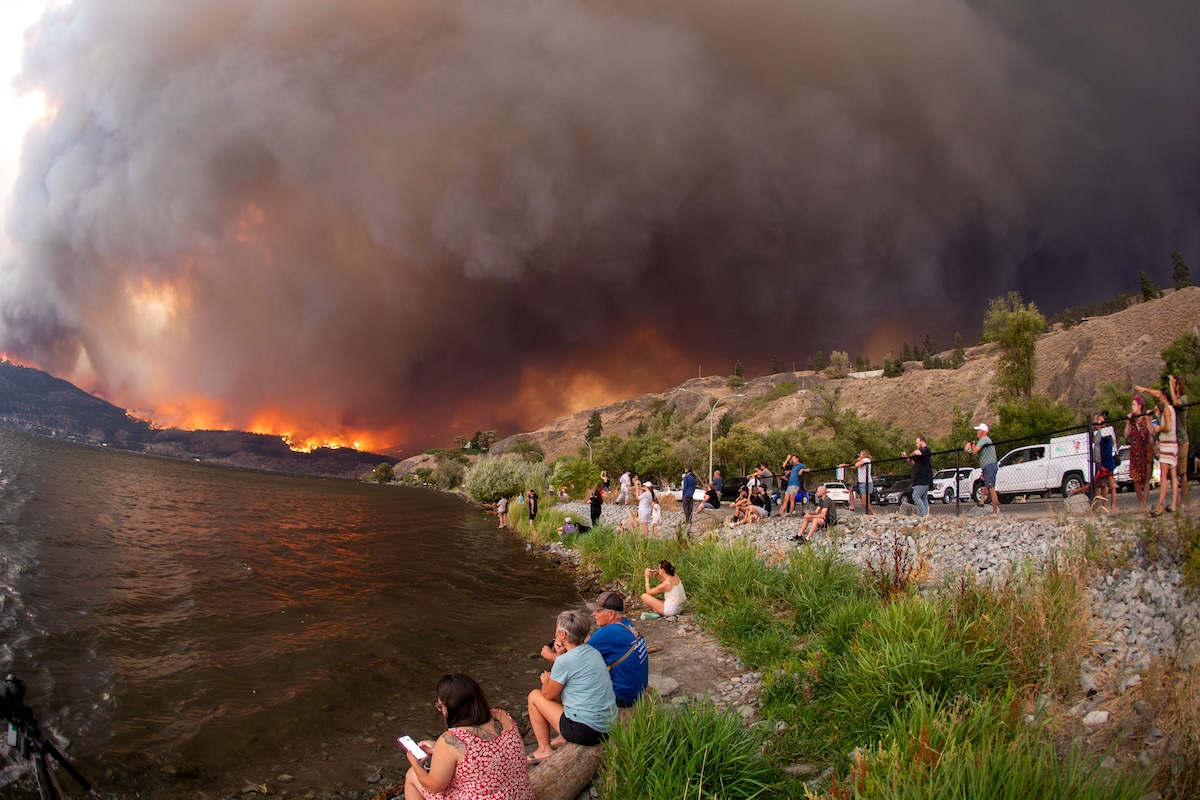
    Residents watch the McDougall Creek wildfire in West Kelowna, British Columbia, Canada
    Residents watch the McDougall Creek wildfire in West Kelowna, British Columbia, Canada, on Aug. 17, 2023. DARREN HULL / AFP via Getty Images
    Why you can trust us

    Founded in 2005 as an Ohio-based environmental newspaper, EcoWatch is a digital platform dedicated to publishing quality, science-based content on environmental issues, causes, and solutions.

    Facebook icon Twitter icon Pinterest icon Email icon

    Since late April, wildfires have been burning across Canada, blanketing the country and parts of the U.S. in unhealthy and sometimes dangerous smoke, in what Canadian wildfire officials have called the worst wildfire season ever recorded.

    In a new study, scientists from the World Weather Attribution (WWA) Initiative examined the conditions that lead to the record series of wildfires and concluded that they were at least twice as probable due to human-caused climate change.

    More From EcoWatch
    • How Well Does Solar Hold Up in Extreme Weather?
    • The Best Solar Panels for Hot Climates
    • The Best Solar Panels for Cloudy Days

    “In today’s climate, intense fire weather like that observed in May-July 2023 is a moderately extreme event, expected to occur once every 20-25 years. This means in any given year such an event is expected with 4-5% probability,” the study said. “Combining lines of evidence from the synthesis results of the past climate, results from historical and future projections and physical knowledge, we conclude that January-July cumulative DSR like that experienced in 2023 is at least seven times more likely to occur, and was 50% higher than it would have been without climate change; that peak fire weather intensity (FWI7x) like the 2023 event is at least twice as likely to occur, and around 20% more intense, than it would have been without human-induced climate change; and that this trend is projected to continue if warming continues.”

    The study, “Climate change more than doubled the likelihood of extreme fire weather conditions in Eastern Canada,” was conducted by scientists from the Netherlands, Canada and the UK.

    The area burned by this year’s wildfire season in Canada is bigger than Greece, reported The Guardian. More than 34 million acres have been burned — more than twice the previous record. 

    “The word ‘unprecedented’ doesn’t do justice to the severity of the wildfires in Canada this year. From a scientific perspective, the doubling of the previous burned area record is shocking. Climate change is greatly increasing the flammability of the fuel available for wildfires – this means that a single spark, regardless of its source, can rapidly turn into a blazing inferno,” said Yan Boulanger, a research scientist at Natural Resources Canada and part of the study team, as The Guardian reported.

    For the study, the scientists used the fire weather index, which measures wildfire risk using a combination of temperature, humidity, rainfall and wind speed. The conditions caused by climate change like higher temperatures, low humidity and less snow cover primed regions across Canada to be more prone to fires by drying out vegetation.

    “This year, high temperatures led to the rapid thawing and disappearance of snow during May, particularly in eastern Québec, resulting in unusually early wildfires,” said Philippe Gachon, a researcher at the Université du Québec à Montréal, as reported by The Guardian.

    Friederike Otto, senior lecturer at the UK’s Grantham Institute and co-founder of WWA, said the influence of climate change on this year’s Canadian wildfire season may be even greater than the figures in the report demonstrate because the estimates used by the researchers were conservative, CNN reported.

    “It’s becoming evident that the dry and warm conditions conducive to wildfires are becoming more common and more intense around the world as a result of climate change,” said Clair Barnes, a Grantham Institute research associate and one of the authors of the report, as reported by CNN.

    Québec has had the most area affected by the wildfires with 12.8 million acres burned so far this year — approximately 26 times more than the average through late August.

    The wildfires have not only affected the air quality in Canada, but in U.S. cities like New York, Minneapolis, Chicago and Seattle.

    Hundreds of fires continue to burn across the country, with one-fifth of them in the Northwest Territories. Thousands of people were ordered to evacuate there last week, with thousands more being evacuated in British Columbia as wildfire smoke floated down into the Pacific Northwest.

    “Until we stop burning fossil fuels, the number of wildfires will continue to increase, burning larger areas for longer periods of time,” Otto said, as The Guardian reported.

    Subscribe to get exclusive updates in our daily newsletter!

      By signing up, you agree to the Terms of Use and Privacy Policy, and to receive electronic communications from EcoWatch Media Group, which may include marketing promotions, advertisements and sponsored content.

      Cristen Hemingway Jaynes

      Cristen is a writer of fiction and nonfiction. She holds a JD and an Ocean & Coastal Law Certificate from University of Oregon School of Law and an MA in Creative Writing from Birkbeck, University of London. She is the author of the short story collection The Smallest of Entryways, as well as the travel biography, Ernest’s Way: An International Journey Through Hemingway’s Life.
      Facebook icon Twitter icon Pinterest icon Email icon

      Read More

      Methane 101: Understanding the Second Most Important Greenhouse Gas
      By Olivia Rosane and Cristen Hemingway Jaynes
      By EcoWatch
      New York Finalizes Rule for New Buildings to Be Electric
      New York is now the first state in the U.S.
      By Paige Bennett
      Mass Die-Off of Western Monarch Butterflies Linked to Pesticides, Study Finds
      A new peer-reviewed study has linked pesticides as a likely
      By Paige Bennett

      Subscribe to get exclusive updates in our daily newsletter!

        By signing up, you agree to the Terms of Use and Privacy Policy, and to receive electronic communications from EcoWatch Media Group, which may include marketing promotions, advertisements and sponsored content.

        Latest Articles

        • Methane 101: Understanding the Second Most Important Greenhouse Gas
          by EcoWatch
          August 5, 2025
        • New York Finalizes Rule for New Buildings to Be Electric
          by Paige Bennett
          August 4, 2025
        • Mass Die-Off of Western Monarch Butterflies Linked to Pesticides, Study Finds
          by Paige Bennett
          August 1, 2025
        • Deepest-Known Animal Communities Found Almost Six Miles Below Sea Level
          by Cristen Hemingway Jaynes
          August 1, 2025
        • Pristine Forest and Endangered Gorilla Habitat at Risk as Half of DRC Opened to Bids for Oil and Gas Drilling: Report
          by Cristen Hemingway Jaynes
          July 31, 2025
        • Global Hunger Fell Overall in 2024, but Rose in Africa and Western Asia as Climate and Conflict Threaten Progress: UN Report
          by Cristen Hemingway Jaynes
          July 30, 2025
        • Probiotic Found to Slow Disease Spread Among Florida Coral
          by Paige Bennett
          July 29, 2025
        • Earth Overshoot Day Reaches Record for Earliest Date
          by Paige Bennett
          July 28, 2025
        EcoWatch

        The best of EcoWatch right in your inbox. Sign up for our email newsletter!

          • Climate Climate
          • Animals Animals
          • Health + Wellness Health + Wellness
          • Insights + Opinion Insights + Opinion
          • Adventure Adventure
          • Oceans Oceans
          • Business Business
          • Solar Solar
          • About EcoWatch
          • Contact EcoWatch
          • EcoWatch Reviews
          • Terms of Use
          • Privacy Policy
          • Learn About Solar Energy
          • Learn About Deregulated Energy
          • EcoWatch UK
          Follow Us
          Facebook 558k
          Twitter 222k
          Instagram 52k
          Subscribe Subscribe

          Experts for a healthier planet and life.

          Mentioned by:
          Learn more
          • Privacy Policy
          • Terms of Use
          • Cookie Preferences
          • Do Not Sell My Information
          © 2025 EcoWatch. All Rights Reserved.

          Advertiser Disclosure

          Our editorial team is committed to creating independent and objective content focused on helping our readers make informed decisions. To help support these efforts we receive compensation from companies that advertise with us.

          The compensation we receive from these companies may impact how and where products appear on this site. This compensation does not influence the recommendations or advice our editorial team provides within our content. We do not include all companies, products or offers that may be available.