

EcoWatch
Facebook 558k Twitter 222k Instagram 52k Subscribe Subscribe
  • Climate
  • Energy
  • Conservation
  • Food + Agriculture
  • Renewables
  • Oceans
  • Policy
  • Insights + Opinion
  • Go Solar Today
      • Top Companies By State
        • California Solar Companies
        • Texas Solar Companies
        • New York Solar Companies
        • Florida Solar Companies
        • See All States
      • Top Incentives By State
        • California Solar Incentives
        • Texas Solar Incentives
        • New York Solar Incentives
        • Florida Solar Incentives
        • See All States
      • Solar Panel Costs By State
        • Solar Panel Costs in California
        • Solar Panel Costs in Texas
        • Solar Panel Costs in New York
        • Solar Panel Costs in Florida
        • See All States
      • Value of Solar by State
        • Is Solar Worth It In California?
        • Is Solar Worth It in Texas?
        • Is Solar Worth It New York?
        • Is Solar Worth It In Florida?
        • See All States
      • Company Reviews
        • Tesla Solar Review
        • Sunrun Solar Review
        • SunPower Solar Review
        • Vivint Solar Review
        • See All Companies
      • Common Solar Questions
        • Can You Get Free Solar Panels?
        • Does Solar Increase Home Value?
        • What’re The Best Solar Batteries?
        • Can You Finance Solar?
        • Where To Buy Solar Panels?
        • Payback On Solar Panels?
      • Solar Resources
        • Interactive Solar Calculator
        • Federal Solar Tax Credit
        • Best Solar Panels For Most Homes
        • Tesla Solar Roof Review
        • Cheapest Solar Panels
      • Companies Compared
        • SunPower vs Tesla Solar
        • SunRun vs Tesla Solar
        • SunRun vs SunPower
        • SunPower vs Momentum Solar
        • SunPower vs ADT Solar
EcoWatch
  • Climate
  • Energy
  • Conservation
  • Food + Agriculture
  • Renewables
  • Oceans
  • Policy
  • Insights + Opinion
  • Go Solar Today
    • Go Solar Today
    • Top Companies By State
      • California Solar Companies
      • Texas Solar Companies
      • New York Solar Companies
      • Florida Solar Companies
      • See All States
    • Top Incentives By State
      • California Solar Incentives
      • Texas Solar Incentives
      • New York Solar Incentives
      • Florida Solar Incentives
      • See All States
    • Solar Panel Costs By State
      • Solar Panel Costs in California
      • Solar Panel Costs in Texas
      • Solar Panel Costs in New York
      • Solar Panel Costs in Florida
      • See All States
    • Value of Solar by State
      • Is Solar Worth It In California?
      • Is Solar Worth It in Texas?
      • Is Solar Worth It New York?
      • Is Solar Worth It In Florida?
      • See All States
    • Company Reviews
      • Tesla Solar Review
      • Sunrun Solar Review
      • SunPower Solar Review
      • Vivint Solar Review
      • See All Companies
    • Common Solar Questions
      • Can You Get Free Solar Panels?
      • Does Solar Increase Home Value?
      • What’re The Best Solar Batteries?
      • Can You Finance Solar?
      • Where To Buy Solar Panels?
      • Payback On Solar Panels?
    • Solar Resources
      • Interactive Solar Calculator
      • Federal Solar Tax Credit
      • Best Solar Panels For Most Homes
      • Tesla Solar Roof Review
      • Cheapest Solar Panels
    • Companies Compared
      • SunPower vs Tesla Solar
      • SunRun vs Tesla Solar
      • SunRun vs SunPower
      • SunPower vs Momentum Solar
      • SunPower vs ADT Solar

The best of EcoWatch right in your inbox. Sign up for our email newsletter!

    • About EcoWatch
    • Contact EcoWatch
    • Terms of Use
    • Privacy Policy
    • Learn About Solar Energy
    Facebook 558k Twitter 222k Instagram 52k
    EcoWatch
    • About EcoWatch
    • Contact EcoWatch
    • Terms of Use
    • Privacy Policy
    • Learn About Solar Energy
    Facebook 558k Twitter 222k Instagram 52k
    Home Science

    Wax Worm Saliva Can Degrade Stubborn Plastic Within Hours, Scientists Find

    By: Olivia Rosane
    Published: October 5, 2022
    Facebook icon Twitter icon Pinterest icon Email icon
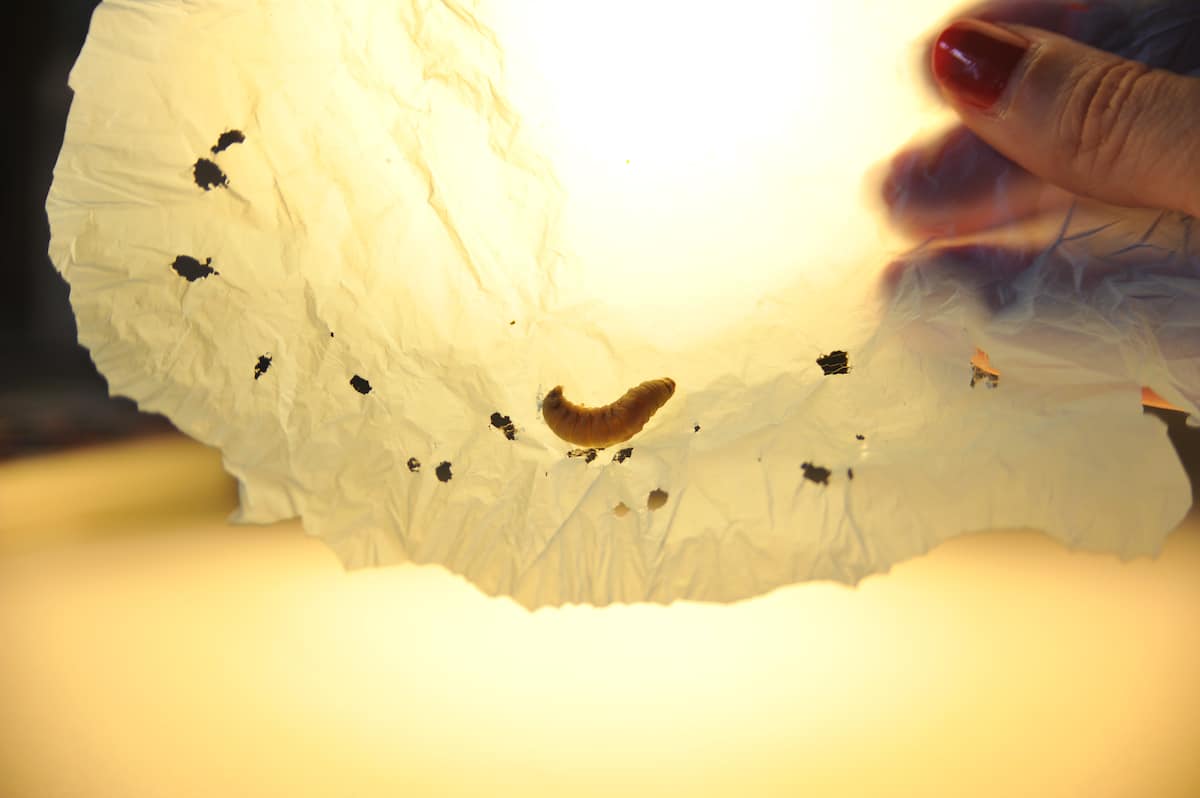
    PE film degraded by wax worms
    PE film degraded by wax worms. César Hernández
    Why you can trust us

    Founded in 2005 as an Ohio-based environmental newspaper, EcoWatch is a digital platform dedicated to publishing quality, science-based content on environmental issues, causes, and solutions.

    Facebook icon Twitter icon Pinterest icon Email icon

    What began as an infestation could be a surprising nature-based solution to the plastic pollution crisis. 

    In 2017, scientist and amateur beekeeper Federica Bertocchini found some unwanted intruders in one of her hives, wax-moth larvae that feed on beeswax. She took the worms out of her hive and placed them in a plastic bag. However, it turned out that the polyethylene (PE) prison would not hold them. 

    “I went back to the room where I had left the worms and I found that they were everywhere,” she told The Guardian at the time. “The bag was full of holes.”

    After conducting further experiments, Bertocchini and her research team concluded that wax worms (Galleria mellonella) could both digest and biodegrade plastic, causing visible damage to a PE-plastic bag in just 40 minutes. They published their findings in Current Biology. However, Bertocchini wanted to know what else the worms could do. 

    Now, in new research published in Nature Communications Tuesday, the team from Madrid’s Margarita Salas Center for Biological Studies (CIB) isolated two enzymes in the wax worms’ saliva that could degrade PE within a couple of hours at room temperature. 

    “To the best of our knowledge, these enzymes are the first animal enzymes with this capability, opening the way to potential solutions for plastic waste management through bio-recycling/up-cycling,” the study authors wrote. 

    #CIBpapers
    A work published in @NatureCommun by the group of Dr. Federica Bertocchini at @CIB_CSIC demonstrates how the saliva of wax worm species contains enzymes able to degrade #plastics opening up an array of applications for treating plastic waste.
    ➡️https://t.co/XfBWhM5jyH pic.twitter.com/5z0zyvd12s

    — CIB Margarita Salas (CSIC) (@CIB_CSIC) October 4, 2022

    PE is a major contributor to the problem of plastic pollution, making up 30 percent of all plastic production. It is often used to make plastic bags, which are the fourth most common plastic item found in the ocean. In addition to being widely used, PE is one of the plastics that is the most difficult to break down. Currently, it is only recycled mechanically, and the process usually results in lower-quality polymers. Further, there are serious questions about the effectiveness of recycling plastic in general, and U.S. recycling rates for the material have dropped to between five and six percent. Yet the substance continues to be produced, used and discarded, showing up everywhere from the ocean floor to Mount Everest. If current trends continue, there will be more plastic in the ocean than fish by 2050. 

    The enzymes found in the worms’ saliva can help with the first, most difficult part of breaking PE down, Bertocchini explained in a CIB press release.

    “For plastic to degrade, oxygen must penetrate the polymer (the plastic molecule). This is the first step in oxidation, which is usually a result of exposure to sunlight or high temperatures, and represents a bottleneck that slows down the degradation of plastics like polyethylene, one of the most resistant polymers,” she said. “That is why, under normal environmental conditions, plastic takes months or even years to degrade.” 

    Yet the enzymes can first oxidize and then degrade the PE polymers within hours. There is still more work to be done before these enzymes are deployed at scale, however.

    “We need to do a lot of research and think about how to develop this new strategy to deal with plastic waste,” study co-author Dr. Clemente Arias, also of CIB, told The Guardian.  

    Nevertheless, the team was excited about the possibilities. 

    “We can imagine a scenario where these enzymes are used in an aqueous solution, and liters of this solution is poured over piles of collected plastic in a waste management facility,” Bertocchini told AFP, adding “We can also imagine small amounts that can reach more remote locations, like villages or small islands, where waste facilities are not available.”

    Subscribe to get exclusive updates in our daily newsletter!

      By signing up, you agree to the Terms of Use and Privacy Policy, and to receive electronic communications from EcoWatch Media Group, which may include marketing promotions, advertisements and sponsored content.

      Olivia Rosane

      Olivia Rosane is an environmental journalist with a decade’s worth of experience. She has been contributing to EcoWatch since 2018 and has also covered environmental themes for Common Dreams, Atmos, Rewilding, Seattle Met, Treehugger, The Trouble, YES! Magazine and Real Life. She holds a Ph.D. in English Literature from the University of Cambridge and a master’s in Art and Politics from Goldsmiths, University of London.
      Facebook icon Twitter icon Pinterest icon Email icon

      Read More

      Methane 101: Understanding the Second Most Important Greenhouse Gas
      By Olivia Rosane and Cristen Hemingway Jaynes
      By EcoWatch
      Mass Die-Off of Western Monarch Butterflies Linked to Pesticides, Study Finds
      A new peer-reviewed study has linked pesticides as a likely
      By Paige Bennett
      Deepest-Known Animal Communities Found Almost Six Miles Below Sea Level
      Thousands of mollusks and worms have been discovered by a
      By Cristen Hemingway Jaynes

      Subscribe to get exclusive updates in our daily newsletter!

        By signing up, you agree to the Terms of Use and Privacy Policy, and to receive electronic communications from EcoWatch Media Group, which may include marketing promotions, advertisements and sponsored content.

        Latest Articles

        • Methane 101: Understanding the Second Most Important Greenhouse Gas
          by EcoWatch
          August 5, 2025
        • New York Finalizes Rule for New Buildings to Be Electric
          by Paige Bennett
          August 4, 2025
        • Mass Die-Off of Western Monarch Butterflies Linked to Pesticides, Study Finds
          by Paige Bennett
          August 1, 2025
        • Deepest-Known Animal Communities Found Almost Six Miles Below Sea Level
          by Cristen Hemingway Jaynes
          August 1, 2025
        • Pristine Forest and Endangered Gorilla Habitat at Risk as Half of DRC Opened to Bids for Oil and Gas Drilling: Report
          by Cristen Hemingway Jaynes
          July 31, 2025
        • Global Hunger Fell Overall in 2024, but Rose in Africa and Western Asia as Climate and Conflict Threaten Progress: UN Report
          by Cristen Hemingway Jaynes
          July 30, 2025
        • Probiotic Found to Slow Disease Spread Among Florida Coral
          by Paige Bennett
          July 29, 2025
        • Earth Overshoot Day Reaches Record for Earliest Date
          by Paige Bennett
          July 28, 2025
        EcoWatch

        The best of EcoWatch right in your inbox. Sign up for our email newsletter!

          • Climate Climate
          • Animals Animals
          • Health + Wellness Health + Wellness
          • Insights + Opinion Insights + Opinion
          • Adventure Adventure
          • Oceans Oceans
          • Business Business
          • Solar Solar
          • About EcoWatch
          • Contact EcoWatch
          • EcoWatch Reviews
          • Terms of Use
          • Privacy Policy
          • Learn About Solar Energy
          • Learn About Deregulated Energy
          • EcoWatch UK
          Follow Us
          Facebook 558k
          Twitter 222k
          Instagram 52k
          Subscribe Subscribe

          Experts for a healthier planet and life.

          Mentioned by:
          Learn more
          • Privacy Policy
          • Terms of Use
          • Your Privacy Choices California Consumer Privacy Act (CCPA) Opt-Out Icon
          © 2026 EcoWatch. All Rights Reserved.

          Advertiser Disclosure

          Our editorial team is committed to creating independent and objective content focused on helping our readers make informed decisions. To help support these efforts we receive compensation from companies that advertise with us.

          The compensation we receive from these companies may impact how and where products appear on this site. This compensation does not influence the recommendations or advice our editorial team provides within our content. We do not include all companies, products or offers that may be available.