

EcoWatch
Facebook 558k Twitter 222k Instagram 52k Subscribe Subscribe
  • Climate
  • Energy
  • Conservation
  • Food + Agriculture
  • Renewables
  • Oceans
  • Policy
  • Insights + Opinion
  • Go Solar Today
      • Top Companies By State
        • California Solar Companies
        • Texas Solar Companies
        • New York Solar Companies
        • Florida Solar Companies
        • See All States
      • Top Incentives By State
        • California Solar Incentives
        • Texas Solar Incentives
        • New York Solar Incentives
        • Florida Solar Incentives
        • See All States
      • Solar Panel Costs By State
        • Solar Panel Costs in California
        • Solar Panel Costs in Texas
        • Solar Panel Costs in New York
        • Solar Panel Costs in Florida
        • See All States
      • Value of Solar by State
        • Is Solar Worth It In California?
        • Is Solar Worth It in Texas?
        • Is Solar Worth It New York?
        • Is Solar Worth It In Florida?
        • See All States
      • Company Reviews
        • Tesla Solar Review
        • Sunrun Solar Review
        • SunPower Solar Review
        • Vivint Solar Review
        • See All Companies
      • Common Solar Questions
        • Can You Get Free Solar Panels?
        • Does Solar Increase Home Value?
        • What’re The Best Solar Batteries?
        • Can You Finance Solar?
        • Where To Buy Solar Panels?
        • Payback On Solar Panels?
      • Solar Resources
        • Interactive Solar Calculator
        • Federal Solar Tax Credit
        • Best Solar Panels For Most Homes
        • Tesla Solar Roof Review
        • Cheapest Solar Panels
      • Companies Compared
        • SunPower vs Tesla Solar
        • SunRun vs Tesla Solar
        • SunRun vs SunPower
        • SunPower vs Momentum Solar
        • SunPower vs ADT Solar
EcoWatch
  • Climate
  • Energy
  • Conservation
  • Food + Agriculture
  • Renewables
  • Oceans
  • Policy
  • Insights + Opinion
  • Go Solar Today
    • Go Solar Today
    • Top Companies By State
      • California Solar Companies
      • Texas Solar Companies
      • New York Solar Companies
      • Florida Solar Companies
      • See All States
    • Top Incentives By State
      • California Solar Incentives
      • Texas Solar Incentives
      • New York Solar Incentives
      • Florida Solar Incentives
      • See All States
    • Solar Panel Costs By State
      • Solar Panel Costs in California
      • Solar Panel Costs in Texas
      • Solar Panel Costs in New York
      • Solar Panel Costs in Florida
      • See All States
    • Value of Solar by State
      • Is Solar Worth It In California?
      • Is Solar Worth It in Texas?
      • Is Solar Worth It New York?
      • Is Solar Worth It In Florida?
      • See All States
    • Company Reviews
      • Tesla Solar Review
      • Sunrun Solar Review
      • SunPower Solar Review
      • Vivint Solar Review
      • See All Companies
    • Common Solar Questions
      • Can You Get Free Solar Panels?
      • Does Solar Increase Home Value?
      • What’re The Best Solar Batteries?
      • Can You Finance Solar?
      • Where To Buy Solar Panels?
      • Payback On Solar Panels?
    • Solar Resources
      • Interactive Solar Calculator
      • Federal Solar Tax Credit
      • Best Solar Panels For Most Homes
      • Tesla Solar Roof Review
      • Cheapest Solar Panels
    • Companies Compared
      • SunPower vs Tesla Solar
      • SunRun vs Tesla Solar
      • SunRun vs SunPower
      • SunPower vs Momentum Solar
      • SunPower vs ADT Solar

The best of EcoWatch right in your inbox. Sign up for our email newsletter!

    • About EcoWatch
    • Contact EcoWatch
    • Terms of Use
    • Privacy Policy
    • Learn About Solar Energy
    Facebook 558k Twitter 222k Instagram 52k
    EcoWatch
    • About EcoWatch
    • Contact EcoWatch
    • Terms of Use
    • Privacy Policy
    • Learn About Solar Energy
    Facebook 558k Twitter 222k Instagram 52k
    Home Oceans

    Climate Crisis Puts Half of Reefs at Risk by 2035

    By: Olivia Rosane
    Published: October 13, 2022
    Edited by Irma Omerhodzic
    Facebook icon Twitter icon Pinterest icon Email icon
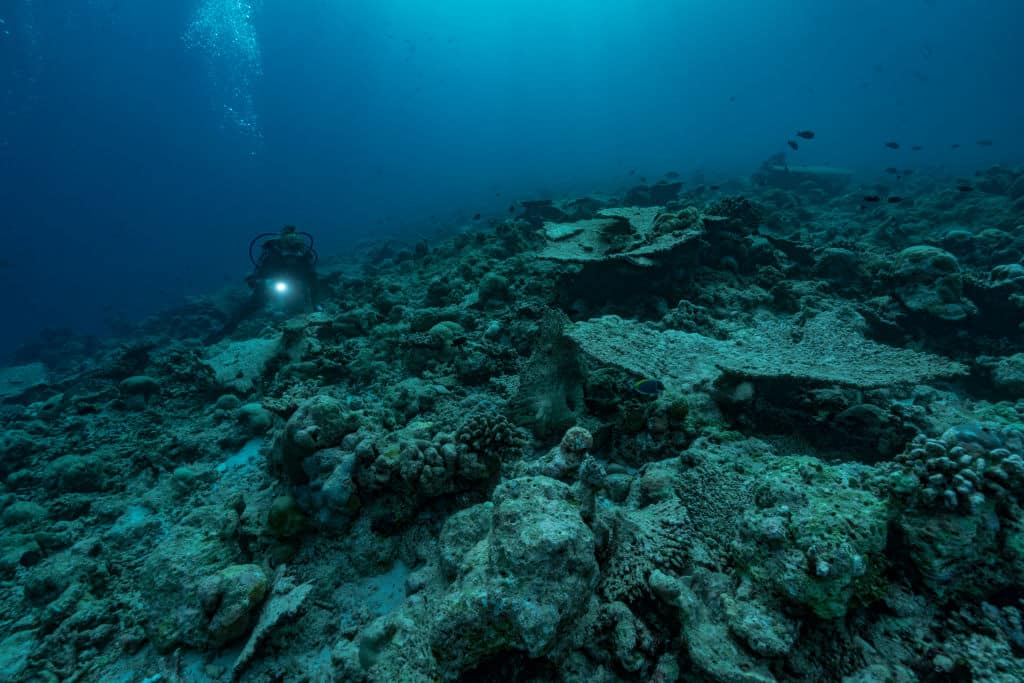
    Dead corals
    Dead corals in the Maldives. Alexis Rosenfeld / Getty Images
    Why you can trust us

    Founded in 2005 as an Ohio-based environmental newspaper, EcoWatch is a digital platform dedicated to publishing quality, science-based content on environmental issues, causes, and solutions.

    Facebook icon Twitter icon Pinterest icon Email icon

    Half of the world’s coral reefs are threatened by 2035 if nothing is done to mitigate the climate crisis. 

    That’s the alarming finding of a new study published in PLOS Biology Tuesday, which found that 50 percent of reefs could face “unsuitable” conditions in just 13 years. 

    “While the negative impacts of climate change on coral reefs are well known, this research shows that they are actually worse than anticipated due to a broad combination of climate change-induced stressors,” lead author and University of Hawaiʻi (UH) at Mānoa Department of Geography and Environment in the College of Social Sciences PhD student Renee O. Setter said in a press release. “It was surprising to find that so many global coral reefs would be overwhelmed by unsuitable environmental conditions so soon due to multiple stressors.”

    🌊 #UHMResearch: 50% of Earth’s coral reefs face climate change threat by 2035 – Stressors analyzed included sea surface temperature, ocean acidification, tropical storms, land use and human population ➡️ https://t.co/AGF6ySzXiV @CSS_UHManoa pic.twitter.com/Z17HBIwva3

    — University of Hawaii at Manoa (@uhmanoa) October 13, 2022

    The fact that coral reefs are in trouble is not news. The climate crisis is currently considered the greatest threat to the world’s reefs, and 14 percent of them were lost because of it between 2009 and 2018 alone. According to the Intergovernmental Panel on Climate Change, even limiting global warming to 1.5 degrees Celsius beyond pre-industrial levels would still see 70 to 90 percent of tropical reefs wiped out.

    The new study builds on these earlier warnings by considering how multiple stressors might interact to harm a reef, instead of focusing on just one factor. 

    “We know that corals are vulnerable to increasing sea surface temperatures and marine heat waves due to climate change. But it is important to include the complete anthropogenic (environmental change caused or influenced by human activity) impact from numerous stressors that coral reefs are exposed to in order to get a better sense of the overall risks to these ecosystems,” study co-author and associate research professor at the Hawaiʻi Institute of Marine Biology in UH Manoa’s School of Ocean and Earth Sciences and Technology Erik Franklin said in the press release.

    The five stressors the research team considered were 

    1. Sea-surface temperature
    2. Ocean acidification 
    3. Tropical storms
    4. Land use pressures 
    5. Human population pressures

    The research team was interested in when one or more of these pressures would generate unsuitable environmental conditions. This means that the reef ecosystem’s health would degrade considerably, but the species calling it home wouldn’t necessarily become locally or globally extinct. To find out, UH Manoa-based team ran different models based on different emissions scenarios considering the impacts of one or multiple stressors. 

    In a worst-case, business-as-usual emissions scenario, they found that just one stressor would push half of reefs into unsuitable conditions by 2050. However, if multiple stressors were considered, half of reefs would reach that point by 2035. For a best-case emissions reduction scenario, the difference was still stark. Looking at just one stressor would see 41 percent of reefs facing unsuitable conditions by 2100, but considering multiple would see 64 percent of reefs reach that point by the century’s end. 

    For the worst-case scenario, predictions were even more dire for the mid and end point of the century, with 99 percent of reefs facing unsuitable conditions due to at least one stressor by 2055 and 93 percent of reefs threatened by two or more stressors by 2100. All of this means that scientists and conservationists need to act faster to save the world’s coral reefs. 

    “Prior studies have indicated the projected dire effects of climate change on coral reefs by mid-century; by analyzing a multitude of projected disturbances, our study reveals a much more severe prognosis for the world’s coral reefs as they have significantly less time to adapt while highlighting the urgent need to tackle available solutions to human disturbances,” the study authors concluded in their abstract. 

    While the paper is global in scope, it also has important local consequences.

    “This has great implications for our local Hawaiian reefs that are key to local biodiversity, island culture, fisheries and tourism,” Franklin said in the press release.

    The team next hopes to study the impact of the climate crisis on individual coral species to determine which are more vulnerable.

    Subscribe to get exclusive updates in our daily newsletter!

      By signing up, you agree to the Terms of Use and Privacy Policy, and to receive electronic communications from EcoWatch Media Group, which may include marketing promotions, advertisements and sponsored content.

      Olivia Rosane

      Olivia Rosane is an environmental journalist with a decade’s worth of experience. She has been contributing to EcoWatch since 2018 and has also covered environmental themes for Common Dreams, Atmos, Rewilding, Seattle Met, Treehugger, The Trouble, YES! Magazine and Real Life. She holds a Ph.D. in English Literature from the University of Cambridge and a master’s in Art and Politics from Goldsmiths, University of London.
      Facebook icon Twitter icon Pinterest icon Email icon

      Read More

      Methane 101: Understanding the Second Most Important Greenhouse Gas
      By Olivia Rosane and Cristen Hemingway Jaynes
      By EcoWatch
      Deepest-Known Animal Communities Found Almost Six Miles Below Sea Level
      Thousands of mollusks and worms have been discovered by a
      By Cristen Hemingway Jaynes
      Pristine Forest and Endangered Gorilla Habitat at Risk as Half of DRC Opened to Bids for Oil and Gas Drilling: Report
      The Democratic Republic of the Congo (DRC) is home to
      By Cristen Hemingway Jaynes

      Subscribe to get exclusive updates in our daily newsletter!

        By signing up, you agree to the Terms of Use and Privacy Policy, and to receive electronic communications from EcoWatch Media Group, which may include marketing promotions, advertisements and sponsored content.

        Latest Articles

        • Methane 101: Understanding the Second Most Important Greenhouse Gas
          by EcoWatch
          August 5, 2025
        • New York Finalizes Rule for New Buildings to Be Electric
          by Paige Bennett
          August 4, 2025
        • Mass Die-Off of Western Monarch Butterflies Linked to Pesticides, Study Finds
          by Paige Bennett
          August 1, 2025
        • Deepest-Known Animal Communities Found Almost Six Miles Below Sea Level
          by Cristen Hemingway Jaynes
          August 1, 2025
        • Pristine Forest and Endangered Gorilla Habitat at Risk as Half of DRC Opened to Bids for Oil and Gas Drilling: Report
          by Cristen Hemingway Jaynes
          July 31, 2025
        • Global Hunger Fell Overall in 2024, but Rose in Africa and Western Asia as Climate and Conflict Threaten Progress: UN Report
          by Cristen Hemingway Jaynes
          July 30, 2025
        • Probiotic Found to Slow Disease Spread Among Florida Coral
          by Paige Bennett
          July 29, 2025
        • Earth Overshoot Day Reaches Record for Earliest Date
          by Paige Bennett
          July 28, 2025
        EcoWatch

        The best of EcoWatch right in your inbox. Sign up for our email newsletter!

          • Climate Climate
          • Animals Animals
          • Health + Wellness Health + Wellness
          • Insights + Opinion Insights + Opinion
          • Adventure Adventure
          • Oceans Oceans
          • Business Business
          • Solar Solar
          • About EcoWatch
          • Contact EcoWatch
          • EcoWatch Reviews
          • Terms of Use
          • Privacy Policy
          • Learn About Solar Energy
          • Learn About Deregulated Energy
          • EcoWatch UK
          Follow Us
          Facebook 558k
          Twitter 222k
          Instagram 52k
          Subscribe Subscribe

          Experts for a healthier planet and life.

          Mentioned by:
          Learn more
          • Privacy Policy
          • Terms of Use
          • Cookie Preferences
          • Do Not Sell My Information
          © 2026 EcoWatch. All Rights Reserved.

          Advertiser Disclosure

          Our editorial team is committed to creating independent and objective content focused on helping our readers make informed decisions. To help support these efforts we receive compensation from companies that advertise with us.

          The compensation we receive from these companies may impact how and where products appear on this site. This compensation does not influence the recommendations or advice our editorial team provides within our content. We do not include all companies, products or offers that may be available.